- icy@wzhgroup.com
- +86 15081877521


If you are considering buying a container house,besides price,size,transportation,and installation,there's another question worth understanding beforehand:What is the fire resistance rating of container houses?
Especially in the United States,Canada,Australia,and some European countries,you may also be particularly concerned about the building's fire resistance rating and fire safety.
This is because the fire resistance rating not only relates to the building's inherent safety but also to whether the project meets local building codes and approval requirements.
Whether you plan to use the container house as a long-term residence,vacation home,Airbnb,office space,or commercial use,its fire resistance performance will directly affect your future user experience.
Some regions require buildings to meet specific fire resistance ratings,and some insurance companies also use building materials and fire resistance performance as assessment criteria.
Next,we will gain a more comprehensive understanding of the actual fire resistance performance of container houses from several aspects,including structural materials,insulation systems,fire resistance ratings,and building codes.
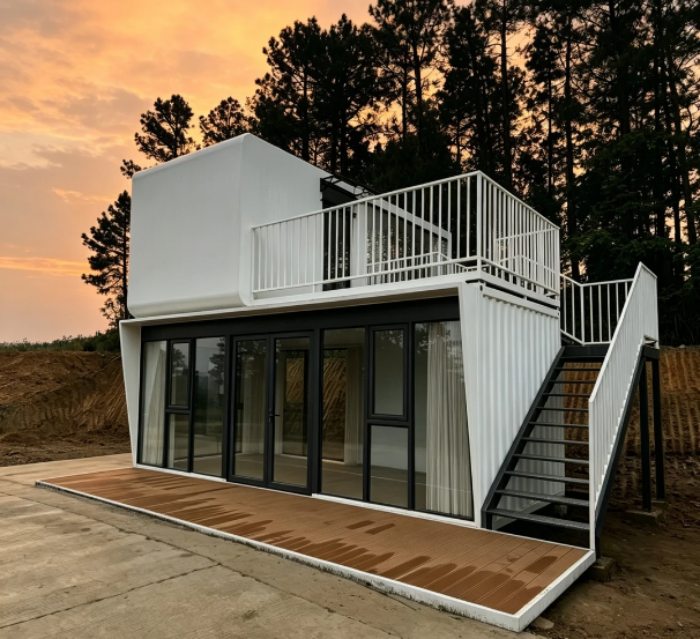
There is no standardized fire rating for container houses;their fire resistance is typically measured by fire rating.Depending on the wall structure,insulation materials,and fire-resistant design,modern container houses can generally achieve a 1-hour to 2-hour fire rating,with some commercial projects even reaching higher standards.
If you are comparing product solutions from different manufacturers,you may find that everyone is advertising their product's excellent fire resistance.However,the fire rating of a container house is not determined by the steel container itself.
The entire building system truly influences fire resistance.
This includes:
Wall structure
Insulation materials
Fire-resistant panels
Electrical system
Door and window system
Fire protection equipment.
In European and American markets,building fire resistance is usually assessed using fire resistance time.
Simply put,it's the time a building can maintain structural stability and integrity under standard fire test conditions.
Common standards include:
Fire Rating | Duration of Fire Resistance |
30-Minute Fire Rating | 30 Minutes |
1-Hour Fire Rating | 1 Hour |
2-Hour Fire Rating | 2 Hours |
3-Hour Fire Rating | 3 Hours |
For most residential projects,a 1-hour fire resistance rating is sufficient to meet building requirements in many areas.However,if your project is a hotel,school,dormitory,or commercial building,a higher fire resistance standard may be required.
The fire resistance rating of a container house is primarily determined by the wall system,insulation materials,interior decoration,fire-resistant construction,and fire-fighting equipment,not just the steel structure itself.
When you first encounter container houses,you might think that since the steel structure itself is non-combustible,these buildings should naturally have high fire resistance.
However,this is not entirely true.While steel is indeed a non-combustible material,the fire resistance rating of a building is not solely determined by the container itself.
You also need to pay attention to:
Insulation layer
Wall panel system
Ceiling structure
Floor system
Electrical wiring
Door and window configuration
If you are comparing two container houses that look almost identical,one using rock wool insulation and the other using ordinary EPS foam insulation,their performance in a fire could be completely different.
While the difference may not be visible from the outside,the internal material configuration directly affects the fire resistance rating.This is why simply comparing prices is often insufficient when purchasing container houses.
Understanding the configuration of the wall and insulation systems is often more important.
Steel itself does not burn,but high temperatures can affect the strength of the steel structure.The risk of fire in container houses comes more from the electrical system,finishing materials,and furniture than from the steel structure itself.
If you think that because steel structures don't burn,container houses are very safe,this understanding is incomplete.
In a fire,a building faces more than just the question of"whether it will catch fire."More importantly,it faces the question of how long the building can remain stable in a high-temperature environment.As the temperature continues to rise,although steel will not burn,its strength will gradually decrease.
Meanwhile,the parts most susceptible to fire typically include:
Electrical wiring
Kitchen equipment
Furniture
Flooring materials
Interior finishes
Therefore,when assessing the safety of a container house,you need to focus on the overall fire-resistant design,not just the steel structure itself.
If fire safety is your top priority,rock wool is usually the better choice;if you want to balance insulation performance and cost,flame-retardant PU is also a common option.
When you start comparing solutions from different manufacturers,you'll often find that even though they are all container houses,the insulation materials used are completely different.
Currently,the three most common choices on the market are:
Rock wool
Polyurethane(PU)
EPS foam board
If your project is located in regions like the United States,Canada,or Australia,and you plan to use it long-term,then rock wool is usually more popular because it is a non-combustible material that provides better fire resistance.
If your project is located in a cold region and you are more concerned about insulation performance,then high-quality flame-retardant PU is also a good choice.
While EPS is cheaper,its fire resistance is generally inferior to the former two.
Therefore,when comparing different quotes,in addition to price,you also need to understand the specific type of insulation material used by the manufacturer.
Depending on the wall structure and fire protection system,modern container houses typically achieve a fire resistance rating of 1 to 2 hours(1-Hour to 2-Hour Fire Rating),and some special projects can even achieve higher standards.
If you are planning a long-term residence,Airbnb,staff dormitory,or commercial building,then fire resistance rating is often an unavoidable issue.
Because in the European and American markets,the fire performance of a building is usually not measured by"Class A"or"Class B,"but by the time the building can remain stable in a fire environment.Simply put,how long can the building withstand the elements?
Currently common standards include:
Fire Rating
30-Minute Fire Rating
1-Hour Fire Rating
2-Hour Fire Rating
3-Hour Fire Rating
180-Minute Fire Rating
If you are just building a regular residence,a 1-hour fire resistance rating is usually sufficient for many regions.If your project is a hotel,school,office building,or a commercial building with a high concentration of people,local regulations may require a higher fire resistance rating.
You'll find that the fire resistance rating isn't affected by the container's size,but rather by the wall system,insulation materials,and overall fireproofing design.
Using rock wool sandwich panels,fire-resistant gypsum board,and fire door systems typically significantly improves a building's fire resistance.
As long as the design and construction comply with local building codes,most container houses can meet the fire requirements for residential and commercial buildings and successfully obtain building permits.
If you plan to build container houses in the United States,Canada,Australia,or Europe,understanding local building codes is a crucial step.
You'll find that different regions have different requirements for building safety.Some regions focus on structural safety.Others focus more on fire resistance ratings,electrical systems,smoke control design,or energy efficiency.
However,approval authorities usually won't reject a project simply because it uses a container structure.They are more concerned with whether the building complies with regulations.
For example:
Does it meet the required fire resistance rating?
Are qualified building materials used?
Does it meet fire safety requirements?
Does it have safe evacuation facilities?
If your project uses a formal design and provides relevant test reports and certifications,obtaining approval is usually not a major problem.
From a structural materials perspective,steel container houses generally have a better fire resistance advantage than traditional log cabins.However,ultimate safety still depends on the overall building design,insulation materials,and fire protection system configuration,not just the structure itself.
If you are comparing container houses and traditional log cabins,fire resistance is likely to be one of the important factors influencing your decision.Especially in wildfire-prone areas such as the western United States,Canada,and Australia,more and more owners are starting to focus on steel structure buildings,hoping to reduce the risk of fire.
The reason is actually not complicated.Wood itself is a combustible material and will gradually burn under sustained high temperatures and open flames.While steel is affected by high temperatures,it will not ignite directly like wood.From this perspective,steel structures generally perform better in a fire.
This is one of the reasons why steel-structured buildings are widely used in industrial plants,warehousing facilities,and commercial projects.However,this doesn't mean all container houses are necessarily safer than wooden houses.If a large amount of flammable interior materials are used,or if the electrical system is poorly designed,there is still a fire risk.
In other words,steel containers provide a better fire-resistant foundation for buildings,but the final safety level still depends on the design and configuration of the entire building system.
Choosing non-combustible insulation materials,optimizing the electrical system,configuring fire-resistant doors and windows,and installing necessary fire-fighting equipment are the most effective ways to improve the fire resistance of container houses.
If you want a higher fire rating,the best approach is not to add fire protection measures after the building is completed,but to incorporate fire protection design into the overall plan during the project planning stage.Many high-fire-rated projects meet strict building codes because relevant requirements were considered during the material selection and structural design phases.
The insulation layer is one of the important factors affecting the fire resistance of container houses.If fire safety is your primary concern,rock wool is generally a better option to consider.
Compared to ordinary insulation materials,rock wool is non-combustible and maintains good stability at high temperatures,preventing the spread of fire.Therefore,rock wool is a common choice for long-term residential,hotel,and commercial buildings.
When you look at high-standard commercial projects,you'll find that fire doors and firewalls are almost standard features.
These systems don't completely prevent fires,but rather slow their spread after they occur,buying more time for evacuation and firefighting.This is especially important for large container building complexes or commercial projects.
In real-world cases,many building fires are related to aging wiring,electrical overloading,or improper construction.
Therefore,when choosing container houses,in addition to focusing on the building structure itself,it's essential to understand whether the electrical system meets local standards.Proper wiring layout,qualified cable materials,and a professional construction team can effectively reduce fire risk.
Even if the building itself has a high fire resistance rating,firefighting equipment remains an essential component.
If the project is intended for long-term residential or commercial operation,consider configuring smoke detectors,fire extinguishers,emergency lighting,and automatic sprinkler systems.While these devices don't directly increase the building's fire resistance rating,they can detect problems early in a fire and help control its spread,thus further enhancing overall safety.
Many people leave fire safety design to the later stages of a project,but in reality,fire performance is often largely determined during the design phase.
If your project requires building permits or meets local fire safety requirements,understanding the local building codes in advance and incorporating appropriate fire safety measures into the design process is usually more efficient and avoids additional costs than later modifications.
If you are evaluating the safety of container houses,then the fire resistance rating is undoubtedly a key indicator to consider.
However,after reading this article,you should realize that there is no fixed"fire resistance rating"for container houses.The true determinant of a building's fire resistance is not the steel container itself,but rather the wall structure,insulation materials,electrical system,and overall fire-resistant design.
From a structural materials perspective,steel containers naturally possess certain advantages.Unlike wood,they do not directly burn.With proper design and standardized construction,modern container houses can typically achieve a fire resistance rating of one to two hours or more,meeting the fire safety requirements of most residential and commercial projects.
If your project is planned for long-term use or requires local building permits,then in addition to focusing on price and appearance,it's crucial to understand the insulation materials,fire protection systems,and relevant certifications used.These unseen components often have a greater impact on future safety and user experience than aesthetic design.
Ultimately,a safe and reliable container house is not just a steel container,but a rationally designed building system that complies with building codes and can be used stably for a long period.
If you're planning a residential,Airbnb,holiday home,staff housing,or commercial project and want to understand the differences between various fire rating options,WZHHouse can provide suitable container home solutions based on your project location,building purpose,and local building codes.
Our team can assist you in assessing:
The fire performance of different insulation materials
The difference between 1-Hour and 2-Hour Fire Rating options
Applicable scenarios for rock wool,PU,and other wall systems
Local building codes and fire safety requirements
Project budget and material selection recommendations Whether you're just starting out with container homes or already in the planning stages,professional advice can help you avoid later design adjustments and additional costs.
Contact WZHHouse today to discuss your project and explore container home solutions that balance safety,compliance,and long-term performance.



Copyright © Hebei Weizhengheng Modular House Technology Co., Ltd. All Rights Reserved
Sitemap




 +8615081877521
 +8615081877521