- icy@wzhgroup.com
- +86 15081877521


Coffee culture continues to grow globally,but the cost of opening a traditional coffee shop is also rising.Soaring rents,longer construction periods,and continuously increasing labor costs are prompting many entrepreneurs to seek more flexible solutions.
This is one of the key reasons for the rapid popularity of shipping container coffee shops in recent years.
Whether in tourist areas,campsites,seaside commercial districts,city streets,or shopping plazas,you can see shipping container coffee shops more and more frequently.Compared to traditional buildings,they not only have a more unique appearance but also shorten construction time and,in many cases,reduce upfront investment.
For most potential buyers,the most pressing question remains:how much does it actually cost to build or buy a shipping container coffee shop?
In fact,there is no single answer to this question.The price is influenced by multiple factors,including size,interior decoration standards,equipment requirements,custom design,and shipping costs.
This article will provide a comprehensive analysis of the cost structure of shipping container coffee shops from a practical purchasing perspective,helping you understand which factors affect the final quote.
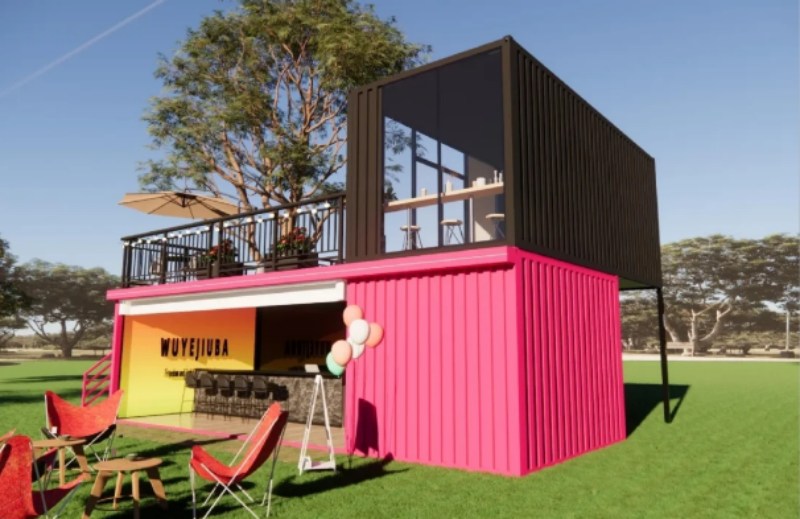
 Shipping Container Coffee Shop Cost.jpg
Most container coffee shops range in price from$10,000 to$45,000,while some highly customized projects can exceed$100,000.
The final price depends primarily on the container size,design complexity,and interior finishing standards.
Common Price Ranges for Container Coffee Shops
Container Coffee Shop Type | Typical Price Range |
Basic Coffee Kiosk | $5,000–$12,000 |
10ft Container Coffee Shop | $8,000–$15,000 |
20ft Container Coffee Shop | $10,000–$25,000 |
40ft Container Coffee Shop | $20,000–$45,000 |
High-End Custom Container Coffee Shop | $40,000–$100,000+ |
It's important to note that the prices above typically refer to the cost of the building itself,not the total investment for the entire coffee shop project.
For example,most suppliers'quotes may include the container's main structure,insulation,electrical wiring,lighting systems,flooring,and sales windows,but coffee-making equipment usually needs to be purchased separately.Therefore,two seemingly similar container coffee shops may have significantly different total investment amounts.
Many people,when initially inquiring about prices,directly ask,"How much does a container coffee shop cost?"However,there's no fixed answer to this question.Even two projects that look similar can have final quotes differing by thousands or even tens of thousands of dollars.
The reason is simple.The container itself is merely the basic framework of the building;the real factors influencing cost are often the subsequent design,decoration,and functional configuration.
Size is usually one of the most direct factors affecting price.
Common sizes on the market include 10-foot,20-foot,and 40-foot containers.For small projects offering only takeaway coffee,a 10-foot container might be sufficient;while if additional counter space,storage space,or even a small waiting area for customers is needed,a 20-foot container is a more common choice.
As for a 40-foot container,it offers more spacious interior space,and can even accommodate a simple dine-in area.However,with the increased area,the costs of steel structures,insulation materials,decoration materials,and transportation all rise accordingly,resulting in a higher overall budget.
Decoration is often one of the biggest factors contributing to price differences.
Some clients want to start operations quickly and therefore opt for relatively simple commercial decoration schemes,such as basic wall panels,non-slip flooring,and standard lighting systems.This configuration meets daily operational needs while helping to control the budget.
However,for some branded cafes,the spatial experience itself is part of the brand.They may add elements such as custom ceilings,distinctive walls,advanced lighting design,wood veneer finishes,and custom furniture.
While these details don't change the building structure,they significantly impact the overall cost.
Many container cafes now use large windows,a popular practice.
From an operational perspective,larger sales windows enhance customer interaction and make the space appear more open and attractive.This design often improves the overall visual appeal,especially in scenic areas,campgrounds,or commercial streets.
However,each large opening means additional structural modifications and steel reinforcement work.For example,panoramic glass curtain walls,extra-wide folding windows,or corner glass designs increase manufacturing complexity and material costs.
Many buyers tend to overlook the importance of plumbing and electrical systems during the budgeting phase.
In fact,coffee shops typically have higher requirements for electricity and plumbing than ordinary commercial spaces.Running a commercial espresso machine,grinder,refrigerator,and lighting system simultaneously places high demands on circuit stability.
In addition,infrastructure such as plumbing,ventilation,and air conditioning systems must be considered.A more complete configuration naturally results in a better user experience,but the corresponding installation and equipment costs will also increase.
For many chain brands or specialty coffee shops,shipping containers are not only sales spaces but also brand showcases.
Therefore,many clients request additional brand logos,exclusive color schemes,custom paintwork,lightbox signage,and even unique facade designs.Some projects also combine wood veneer,perforated aluminum panels,or glass curtain walls to create a more distinctive appearance.
While these personalized designs increase the project budget,from a long-term operational perspective,they often help the brand establish a more distinctive market image and enhance customer brand recall.
Why are container coffee shops becoming increasingly popular?A few years ago,container architecture was more commonly seen in architectural design magazines or creative business case studies.Many considered it a novel architectural form,but large-scale commercial application seemed a distant prospect.
Now,however,container cafes are becoming increasingly common in urban commercial streets,seaside resorts,and campgrounds.For many entrepreneurs and investors,it's no longer just a"creative option,"but a market-proven business solution.
Of course,the appeal isn't solely based on price.
For commercial projects,time often translates to cost.
Traditional cafes typically take 6 to 12 months from design and approval to construction completion,with complex projects taking even longer.Container cafes,on the other hand,mostly utilize prefabrication in factories,allowing the main structure,doors and windows,insulation,and some interior decoration to be completed in advance.
According to data from the modular construction industry,prefabricated construction can typically shorten the overall construction cycle by approximately 30%to 50%.Many standardized container cafe projects can be completed from design confirmation to operation in just 6 to 12 weeks.
For entrepreneurs looking to open as soon as possible,this means starting operations earlier and generating cash flow sooner.
Controlling startup capital is always a crucial task for most startups.
Opening a traditional coffee shop involves costs beyond rent,including renovations,construction,labor,and a lengthy development period.In some cities,renovation and construction costs alone can account for over 30%of the total investment budget.
In contrast,container coffee shops can significantly reduce on-site construction work.For small startups with budgets between$20,000 and$50,000,this model often allows operators to invest more in coffee equipment,brand promotion,and product development.
Today,consumers choose a coffee shop for more than just a cup of coffee.
Increasing research shows that the consumption environment and spatial experience are becoming important factors influencing customer decisions.Especially with the rise of social media platforms like Instagram and TikTok,a distinctive space often gains more organic exposure.
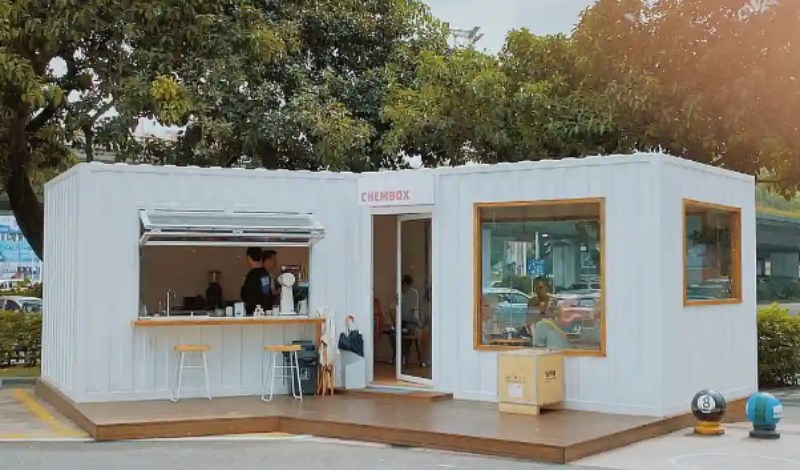
Container coffee shops themselves possess a distinct industrial aesthetic.Through combinations of glass curtain walls,wood veneer,terrace platforms,and custom brand designs,many projects create unique visual focal points.
For coffee brands that rely on offline traffic and social media buzz,this inherent topicality often holds added value.
Besides appearance and cost,flexibility is another key reason for the popularity of container coffee shops.
Unlike traditional buildings,most of the construction work for container coffee shops is completed in the factory,with many products already 70%to 90%complete when they leave the site.Upon arrival,only hoisting,equipment connection,and minor debugging are required before operation.
Currently,these projects are widely used in:
Tourist attractions
Camping sites
Seaside commercial districts
City parks
University campuses
Commercial complexes
Music festival venues
For seasonal projects or temporary commercial events,rapid deployment is often more important than simply reducing construction costs.
In recent years,consumer interest in standardized stores has been declining,while commercial spaces with distinctive experiences and personalized designs are becoming increasingly popular.
Container coffee shops perfectly align with this trend.It allows for control over initial investment risks while enabling the creation of a differentiated brand image through customized design.
For entrepreneurs,this means testing the market with a relatively controllable budget;for investors,it means faster project implementation and business model validation.This is a key reason why more and more scenic area operators,commercial real estate projects,and coffee brands are adopting container commercial spaces.
shipping container coffee shop.jpg
When you start planning your container coffee shop project,you'll quickly encounter a practical question:should you choose a 20-foot or 40-foot container?
From the outside,they may seem like just different sizes,but in reality,this decision directly impacts your investment budget,operating model,and future development potential.
If your goal is to create a small coffee shop primarily for takeout,a 20-foot container is usually sufficient for daily operations.However,if you want to add a dine-in area,expand your menu,or create a more complete coffee consumption experience,a 40-foot container is often more suitable.
Comparison of 20ft and 40ft Container Coffee Shops
Feature | 20ft Container Coffee Shop | 40ft Container Coffee Shop |
Usable Area | Approx. 13–15 m² | Approx. 28–30 m² |
Initial Investment | Lower | Higher |
Transportation Cost | Lower | Higher |
Staff Capacity | 2–3 People | 4–6 People |
Customer Capacity | Primarily Takeout Service | Can Include Dine-In Seating |
Best For | Startups, Small Coffee Kiosks | Tourist Attractions, Commercial Projects |
Estimated Price | $10,000–$25,000 | $20,000–$45,000+ |
If you are in the early stages of your business or want to test local market demand,a 20-foot container is usually a more reliable choice.
With proper planning,a 20-foot container can fully accommodate a coffee preparation area,equipment storage area,and basic workspace.For coffee brands primarily focused on takeout,this area is sufficient for daily operations while effectively controlling initial investment.
A 40-foot container offers even more possibilities.The extra space not only accommodates more equipment and staff,but can also be used to plan customer waiting areas,bar seating,or even small dining areas.If your project is located in a tourist area,seaside commercial district,or campground,the additional operating space often generates more revenue opportunities.
Of course,larger space also means a higher budget.
Besides the increased cost of the building itself,transportation,decoration,and subsequent operating costs usually increase accordingly.Therefore,before choosing the size,you need to consider not only the building area,but more importantly,the future business model and customer traffic demand.
If you are comparing container coffee shops and traditional building coffee shops,price will likely be one of the most important factors in the decision-making process.
From an overall investment perspective,container coffee shops are generally indeed more economical,but their biggest advantage is not just the reduced construction costs.
More importantly,it helps you enter the market faster.
Traditional Coffee Shop vs.Container Coffee Shop:Cost and Flexibility Comparison
Category | Traditional Coffee Shop | Container Coffee Shop |
Initial Construction Cost | Higher | Lower |
Time to Open | 6–12 Months | 6–12 Weeks |
Labor Requirements | Higher | Lower |
Future Expansion | More Difficult | Easier |
Relocation Options | Permanent Structure | Can Be Relocated |
On-Site Construction Work | Extensive | Minimal |
Let's say you plan to open a small to medium-sized coffee shop.If you choose a traditional building,the entire process,from site construction to completion,typically takes six months or even longer.During this time,you may have already started paying rent,labor,and other operational setup costs,but the store hasn't yet generated revenue.
In contrast,most of the construction work for a container coffee shop is done in a factory.Many projects,from design confirmation to on-site installation,only take about 6 to 12 weeks.This means you can open earlier and start generating cash flow sooner.
For a simple example,if your coffee shop generates an average of$5,000 to$15,000 in revenue per month,opening three months earlier theoretically means gaining an additional$15,000 to$45,000 in revenue opportunity.
In addition,you need to consider future development potential.Traditional buildings,once completed,often face high costs for renovation and relocation.Container coffee shops,however,offer greater flexibility,and in some cases,can even be moved entirely to a new location.
For entrepreneurs or those exploring new markets,this flexibility can reduce long-term operational risks and allow for greater flexibility in adjusting your business plan.
If you're already planning your container coffee shop project,besides price,another equally important question is:how to find a supplier who truly understands your business needs?
For coffee shops,a successful project is more than just converting a container into a sales space.The rationality of the sales flow,the efficiency of the equipment layout,the comfort of the customer experience,and the future scalability all directly impact subsequent business performance.
WZHhouse specializes in container commercial buildings and modular space solutions,providing customized container coffee shop design and manufacturing services to clients worldwide.
Whether you plan to create:
Small takeaway coffee window
Tourist area coffee shop
Seaside coffee shop
Campsite coffee shop
Commercial complex coffee space
Chain brand coffee shop
WZHhouse can provide customized solutions based on your business model,site conditions,and budget requirements.
In addition to standard 20-foot and 40-foot container coffee shops,we also support a variety of customized configurations,including:
•Panoramic glass facade
•Folding sales windows
•Outdoor terrace platform
•Customized branded exterior
•LED signage system
•Integrated internal plumbing and electrical systems
•Insulation and air conditioning configuration
For overseas clients,we also offer a one-stop service from design and production to transportation,helping projects to be implemented more smoothly.
If you are currently evaluating your project budget or want to understand the price range for different sizes and configurations,communicating with our professional team in advance can usually save a lot of time.
Sometimes,a reasonable layout can even improve operational efficiency more than simply increasing the area.
Ready to Start Your Container Coffee Shop Project?Whether you are just starting to learn about container coffee shops or already have a clear business plan,WZHhouse can help you assess your project needs and provide free design advice and quotes.
Contact our team to get the container coffee shop solution suitable for your project and bring your ideas to life faster.



Copyright © Hebei Weizhengheng Modular House Technology Co., Ltd. All Rights Reserved
Sitemap

 +8615081877521
 +8615081877521