- icy@wzhgroup.com
- +86 15081877521


In recent years,**prefab container homes**have become increasingly popular worldwide.From holiday homes in North America to modern micro-homes in Europe,and B&B projects in Australia and Asia,container homes are quietly changing people's understanding of"living in small spaces."
If you're considering buying a container home abroad but don't know where to buy it,this article will provide a complete guide.It will help you learn more about container home manufacturers and what factors you need to consider when purchasing.
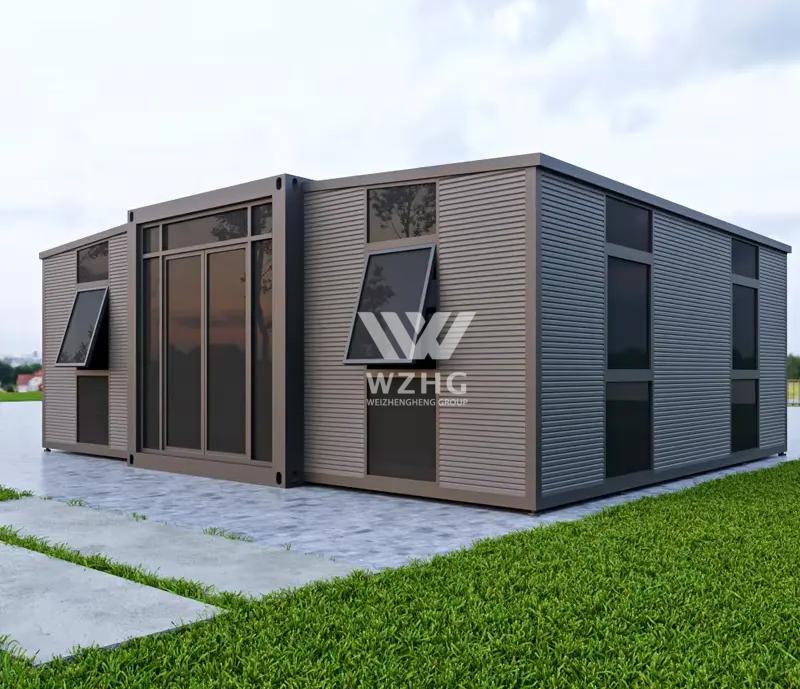
Before diving into the buying channels,let's briefly understand prefab container homes.
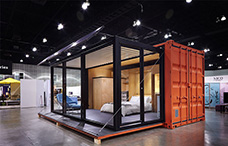
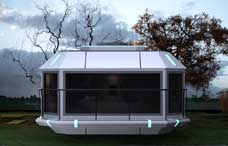
Prefab container homes,as the name suggests,are homes built using standardized shipping containers as a base,either through modification or factory prefabrication.Their characteristics include:
Modular Design:Each container is an independent module that can be combined to create a larger home.
Convenient Transportation:After factory processing,they can be directly transported to the destination for on-site assembly.
Short Construction Cycle:Compared to traditional homes,prefab container homes are built very quickly,typically taking only a few weeks to a few months from design to move-in.
Widely applicable:Can be used as long-term residences,vacation homes,bed and breakfasts,or commercial office space.
However,before choosing a container house,you need to clarify several key points:intended use,area and layout requirements,local building codes,and transportation conditions.These will directly affect your purchase and usage experience.
For overseas users,choosing a well-established brand is one of the most worry-free options.Several internationally renowned manufacturers are worth considering:
Honomobo(Canada):Focuses on modern prefabricated container houses,providing complete customization services.Whether it's a single house or a multi-unit combination,they can complete the design and construction according to North American building codes,making it ideal for long-term residences or vacation homes.
MODS International(USA):Flexible modular design suitable for family homes or commercial uses.Many projects use standardized modules,quickly forming complete houses through on-site assembly.
CubeHaus(Europe):Emphasizes environmental protection and modern design,suitable for the European market,while providing complete piping,insulation,and lighting solutions.
WZHhouse(China):A leading container house manufacturer in China,supporting exports to many countries and regions worldwide,while also providing customized design services and online purchasing.WZHhouse's modular homes can be flexibly combined according to customer needs.Whether using a single container or multiple units,they can meet various purposes,from private residences to guesthouse projects.
For international users,the advantages of choosing WZHhouse are:the manufacturer has extensive export experience,can communicate design plans remotely,and provides complete transportation and installation guidance,allowing overseas customers to easily obtain high-quality container homes.
In addition to directly contacting manufacturers,international users can also find options through online B2B platforms and specialized housing websites:
Alibaba/Made-in-China:These platforms offer a large number of container house suppliers.Users can browse specifications,prices,and design plans online.Some manufacturers support international shipping.
Container Home Hub,Container Homes USA:Container housing platforms specifically targeting the North American market,providing a one-stop service from design,transportation to installation.
The advantage of using these platforms is the wide selection and the ability to compare prices and designs.However,it is also important to verify the supplier's qualifications,export experience,and after-sales service capabilities;otherwise,transportation or installation problems may arise.
Many modular housing companies abroad also offer container housing solutions.Local dealers in North America,Europe,and Australia often have the following advantages:
They can see actual samples,providing a more intuitive understanding of the housing layout and material quality.
Installation and after-sales service are more convenient,meeting local building codes and permit requirements.
They can provide local building materials and plumbing solutions,making the housing more suitable for long-term living.
If you plan to live there long-term or want to complete housing construction quickly,local dealers are a more reliable choice,especially in the United States,Canada,and Australia,where many dealers also offer customized design and transportation services.
In addition to brand-new prefabricated housing,some companies in the international market also offer used container renovation services.The advantages are low cost and high flexibility,suitable for projects with limited budgets or short-term vacation rentals.
However,several issues need to be considered with this type of solution:
Is the container structure safe?Has it been treated for corrosion protection?
Does the insulation and heat insulation meet living standards?
Are the water and electricity lines and drainage systems reliable and suitable for long-term use?
If it's just a short-term guesthouse or temporary residence,used container renovations can meet basic needs.However,if you plan to live there long-term,it's recommended to choose a manufacturer with complete design and construction plans.
When considering buying prefab container homes,there are several key factors that must be considered in advance;otherwise,even the most beautiful house may not be suitable for habitation.For overseas users,advance planning is especially important,as it involves transportation,customs,and local regulations.
First,clarify your intended use.Is it a long-term residence,a vacation home,or a short-stay project?
If it's just for a single person or a couple,a standard 40-foot container is usually sufficient.You can divide the space into a bedroom,kitchen,living room,and bathroom,and with multifunctional furniture,you can live comfortably.Imagine opening the window in the morning,letting the sunlight stream into the warm space,and easily enjoying life;this simple and compact space actually makes life more meaningful.
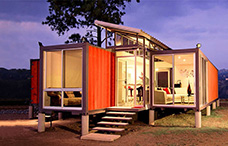
However,for a family of three or four,the area of a single container may feel cramped.At this point,many people opt for modular design:two or three containers side-by-side,combined in an L-shape,or stacked vertically.This not only increases the number of bedrooms but also makes the living room,kitchen,and storage space more spacious,significantly improving the overall living experience.
When purchasing container houses abroad,transportation and installation are crucial considerations.Although containers are structurally robust,handling and sea freight still require professional expertise.
A practical suggestion is to contact the supplier or local dealer in advance to assess transportation and landing feasibility and obtain the necessary construction permits.This avoids the awkward situation of discovering installation limitations after purchase.
While container homes are modular,interior design remains paramount.Good design is not only aesthetically pleasing but also directly impacts living comfort.
Key considerations include:
Insulation and Ventilation:Insulated walls and double-glazed windows ensure warmth in winter and coolness in summer.
Natural Light:Large windows or skylights make the space bright and open.
Easy Layout:The flow of movement between bedrooms,kitchen,and bathrooms should be smooth to avoid overcrowding.
Storage and Multifunctional Furniture:Folding tables,under-bed storage,and hidden cabinets maximize space while maintaining tidiness.
Imagine sunlight streaming into the living room every morning;the folding table can be folded up to create space for exercise or family activities.This flexible design makes small spaces truly suitable for long-term living.
Regulations for container homes vary significantly across different countries and regions.For example,some North American states allow direct landing,while others may require approval according to specific building standards.Europe and Australia also have their own regulations.
It is recommended to consult local government departments or experienced dealers before purchasing to confirm that the design,dimensions,foundation requirements,and fire safety standards of the residence comply with regulations.This can avoid the risk of forced demolition or modification due to violations later.
Finally,and most practically,is the budget.The price of a container home includes not only the cost of the container itself but also modification costs,transportation,and on-site installation costs.
If you plan to live there long-term,it is advisable to allocate sufficient funds in your budget for insulation,plumbing,electrical and plumbing installation,and future maintenance.After all,a comfortable,warm,and fully functional container house is not just about buying a container;it's about buying a home where you can live with peace of mind.
Buying a prefabricated container house may seem simple,but it involves multiple stages,including design,transportation,installation,and local regulations.To make the purchase process smoother and ensure the house is suitable for long-term use,consider the following practical suggestions:
Whether you are in North America,Europe,or Australia,prioritize manufacturers with successful track records and international export support.These manufacturers are familiar with transportation processes,export documents,and local regulations,which can help you avoid many unexpected problems.
If your country allows local installation,prioritize local modular housing dealers.This results in lower transportation costs,faster installation,and more convenient after-sales service.
If there is no suitable local manufacturer,choose a manufacturer that can export,and confirm the transportation plan and customs clearance process in advance.
Before placing an order,be sure to confirm that the manufacturer provides a complete design,insulation,piping,ventilation,and installation plan.Don't just buy an empty shipping container;otherwise,the cost of later modifications can be very high,and it may not meet local building codes.
If you plan to live there long-term,pay special attention to insulation,lighting,and storage design.
Comparing quotes and design solutions from multiple suppliers allows you to understand market conditions and choose the most cost-effective option.The comparison should include not only price but also transportation methods,installation time,and after-sales service.
Some manufacturers offer remote installation guidance,while others provide on-site construction teams.Choose the one that best suits your needs.
When buying abroad,referring to successful cases with climates similar to your location is very helpful.For example,if you are in a hot summer region like Australia or South America,seeing the effects of container homes with insulated and ventilated designs in similar climates will be more intuitive.
Buying a container home involves not only purchasing the container itself but also the costs of modification,transportation,installation,and ongoing maintenance.You need to allocate a certain budget for insulation,piping layout,and optimization of furniture and storage systems to truly have a comfortable living space.
Through these practical suggestions,even if you are overseas,you can more confidently purchase a high-quality container house suitable for long-term living,while reducing subsequent problems and unnecessary expenses.
Purchasing a prefabricated container house is no longer an unattainable dream.Whether you are in North America,Europe,Australia,or Asia,as long as you choose the right channels,you can easily own a modular,customizable,high-quality home.
The core points are simple:clearly define your purpose,number of residents,and budget,and choose a qualified and experienced supplier.A single 40-foot container is suitable for singles or couples,while for larger families,space and functionality can be expanded through modular combinations.
For overseas users,choosing a container house manufacturer like WZHhouse,which has export capabilities and supports remote design communication and transportation guidance,can make the purchase and installation process smoother,truly achieving one-stop management from design to move-in.
If you'd like to try a flexible,fast,and sustainable small-space home,you can start planning your container home now—contact WZHhouse for customized solutions and quotes to turn your dream home into reality step by step.



Copyright © Hebei Weizhengheng Modular House Technology Co., Ltd. All Rights Reserved
Sitemap

 +8615081877521
 +8615081877521