- icy@wzhgroup.com
- +86 15081877521


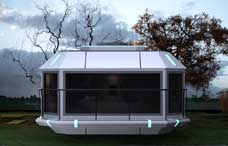
If you have recently been keeping an eye on campsites,rural homestays,or various new types of commercial spaces,you have likely encountered a name quite frequently:the"Apple Cabin."
It does not appear as"cumbersome"as a traditional house,nor does it possess the distinct industrial aesthetic typical of standard shipping containers.The reason many projects have begun adopting this form is not simply because it is"trendy,"but rather because it strikes a superior balance between efficiency,cost-effectiveness,and spatial experience.
When first learning about this concept,many project managers often share similar questions:Is this structure truly suitable for long-term use?What specific scenarios is it best suited for?Can it serve as a viable substitute for traditional buildings?Underlying all these inquiries is a single core question:Does it genuinely address actual,practical needs?
In the following sections,we will examine the Apple Cabin from the perspective of practical application,breaking down its features step by step.
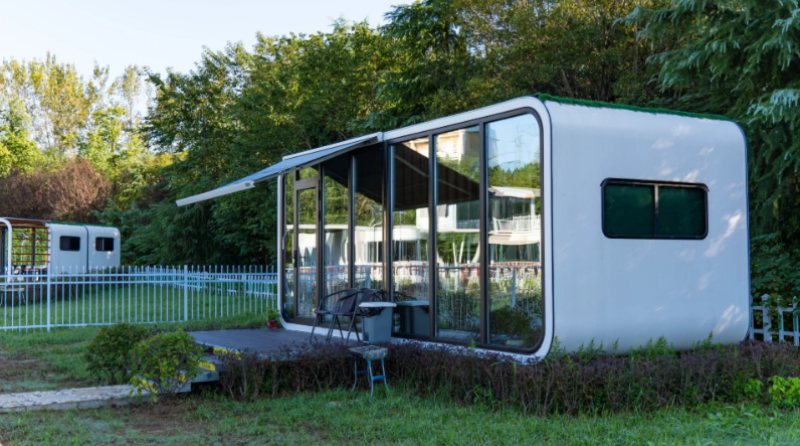
Fundamentally,the Apple Cabin is a prefabricated spatial product built upon a steel structure framework.Typically,the majority of the production process—including the main structural frame,the building envelope system,and a portion of the interior fixtures—is completed at a factory before the unit is transported to the site for final installation.
However,simply defining it as a"modular house"would not be entirely accurate.A more precise description is that the Apple Cabin is a spatial solution designed specifically to facilitate"rapid deployment and immediate use."
Its design philosophy extends beyond merely providing a habitable space;it aims to deliver a fully functional environment—complete with a relatively comprehensive user experience—in the shortest possible timeframe.
When we shift our focus from mere material specifications to the practical realities of usage,we discover that its advantages are often manifested in specific,tangible details—advantages that,in the context of many projects,can be objectively quantified.
Traditional construction projects typically involve multiple distinct phases—including foundation work,structural erection,and interior finishing—resulting in an overall construction timeline that often spans 2 to 6 months(or even longer in cases involving complex regulatory approvals or intricate construction requirements).
In contrast,the Apple Cabin completes approximately**80%to 90%**of the entire production process off-site within a factory setting,leaving only the hoisting and interconnection of units to be performed on-site.
The actual on-site installation time for a single unit typically ranges from 1 to 3 days.
The entire process—from initial production through to final handover for use—is generally completed within a timeframe of 2 to 4 weeks.
Overall,this approach allows for a reduction in the total project timeline of approximately 50%to 70%.For campsites,scenic areas,or commercial ventures,this compressed timeline signifies not only a faster launch but also an earlier start to recouping investment.
In traditional construction,labor costs,material waste,and extended construction cycles often lead to escalating total costs.Budget fluctuations become particularly pronounced when the proportion of on-site construction work is high.
Through standardized manufacturing,the Apple Cabin minimizes these uncertainties to a significantly lower level:
•On-site labor requirements can be reduced by approximately 30%–50%.
•Material utilization efficiency can be boosted to over 90%.
•Overall construction costs can typically be lowered by about 15%–30%.
More importantly,its cost structure is highly transparent.Most expenses can be accurately estimated during the preliminary planning phase,resulting in relatively few instances of additional expenditures later in the project.
For projects where managing budgetary risk is critical,this"predictability"is often more valuable than simply securing the lowest price.
Traditional buildings often prioritize structural integrity during the design phase,leaving functional layouts to be adjusted iteratively later on—a process that frequently results in inefficient or unbalanced space utilization.
The Apple Cabin integrates all functional elements right from the initial design stage,ensuring that limited space is utilized with maximum efficiency:
•The ratio of usable floor area to total area can reach 85%–95%.
•Compared to traditional small-scale structures,space utilization efficiency is improved by approximately 10%–20%.
For instance,within a footprint of approximately**20–40 square meters**,it is typically possible to fully accommodate:
•A private bedroom or sleeping area.
•A complete bathroom system.
•A small living room or lounge area.
This"highly integrated"design ensures that the space is not merely functional,but utilized in the most rational and effective manner possible.
In commercial and cultural tourism projects,a structure's exterior appearance often directly shapes the user's first impression and significantly influences its potential for publicity and social media engagement.In contrast to the relatively monolithic aesthetics of traditional modular housing,the Apple Cabin achieves a far greater degree of design freedom through structural optimization and the strategic combination of materials:
Glass surface area for natural lighting can account for 30%to 50%of the total exterior.
Customizable exterior designs can satisfy the requirements of over 70%of project briefs.
In actual operational scenarios,feedback from various scenic spots and campsites indicates that the adoption of these design-centric accommodation units yields tangible benefits:
The rate at which users take and share photos increases by approximately 20%to 40%.
The average length of customer stays increases by approximately 15%to 25%.
While these metrics may vary depending on the specific project,it is evident that exterior design is no longer merely about looking"attractive";rather,it directly impacts operational performance.
Once constructed,traditional buildings entail high costs for subsequent modifications—or may even render structural alterations virtually impossible.The Apple Cabin,however,is designed from the outset with the need for flexible application in mind.
In terms of usage,the Apple Cabin allows for easy disassembly,relocation,and reassembly,boasting a reusability rate exceeding 80%.This inherent flexibility is particularly valuable for projects with extended timelines or those subject to a high degree of planning uncertainty.
The Apple Cabin not only mitigates your initial decision-making risks but also ensures that your physical space can evolve alongside the project's development,rather than remaining static after a one-time capital investment.
In practical application,based on their structural form and intended usage,Apple Cabins can be broadly categorized into three distinct types.There is no absolute hierarchy of superiority or inferiority among these types;rather,each corresponds to a specific set of operational requirements.
The Integrated Apple Cabin can be best described as a"turnkey delivery"solution.The majority of the structural components and internal systems are fully assembled within a factory environment;upon delivery to the site,the unit can be hoisted into place and immediately put into service.
The defining characteristic of this format is its ability to minimize construction-related uncertainties.Since all critical fabrication processes take place within a controlled factory setting,construction quality remains highly consistent,requiring only simple connections and system commissioning once on-site.For projects requiring rapid deployment—such as campsite accommodations or temporary reception areas—this approach often proves to be the most efficient.
Naturally,this format does entail certain limitations—for instance,transportation dimensions may impose constraints on the maximum size of a single unit.However,in many real-world projects,this very constraint serves to encourage more compact and efficient design solutions,thereby optimizing overall space utilization.
The Expandable Apple Cabin places a greater emphasis on"adaptability."During transport,the unit typically maintains a compact volume to minimize shipping costs;once deployed on-site,however,it expands to provide a significantly larger usable area.
The advantages of this structural design are particularly evident in settings where the quality of the living experience is a top priority—such as in boutique guesthouses or long-term residential spaces.In these contexts,users tend to prioritize interior comfort and ambiance over mere external aesthetics.By utilizing an expandable structure,the interior feels far more spacious and open when in use,offering an experience that closely mirrors that of a traditional permanent dwelling.
From a practical standpoint,this design strikes an effective balance between cost-efficiency and user experience.It avoids the excessive capital investment typically associated with fixed,permanent structures,while simultaneously sidestepping the functional compromises often imposed by limited spatial constraints.
The modular assembly-style Apple Cabin represents a more comprehensive,"systematized architectural solution."It involves the combination of multiple standardized modules to construct more complex and intricate spatial configurations.
This approach offers distinct advantages in larger-scale developments—such as resort hotels or commercial complexes—where projects are rarely completed in a single,monolithic phase but rather progress through a series of incremental stages.The modular nature of the design allows the spatial layout to expand gradually in response to evolving needs,thereby avoiding the necessity of committing to a massive upfront investment.
From a long-term perspective,this method is highly conducive to risk management.It enables project operators to continuously fine-tune the layout during the operational phase—optimizing the spatial structure based on real-world feedback—rather than being locked into a rigid,immutable design established at the very outset.

When first encountering the Apple Cabin,many people instinctively associate it with the"trendy internet-famous guesthouse"phenomenon,viewing it primarily as a novelty accommodation designed for social media photo ops.However,when examined within the operational logic of actual commercial projects,its scope of application proves to be far broader;it has effectively expanded to encompass a diverse array of sectors,including cultural tourism,commercial retail,agriculture,and various forms of temporary infrastructure.
Cultural tourism and camping sites represent one of the primary and most concentrated application scenarios for the Apple Cabin.Projects within this category typically share a common set of characteristics:they face tight construction deadlines and strict launch schedules,while simultaneously requiring a strong visual appeal to underpin their overall operational strategy and marketing efforts.
In terms of practical implementation,a medium-sized camping resort,for instance,often faces the challenge of erecting its entire accommodation inventory—which may range from 10 to 50 independent living units—within an exceptionally compressed timeframe.If traditional construction methods are employed,the entire project cycle could span anywhere from 3 to 6 months—or even longer.In contrast,because the Apple Cabin is largely prefabricated in a factory setting,on-site installation can typically be condensed to just 1 to 2 months;the installation of a single unit can often be completed in as little as 1 to 3 days.
This disparity in construction time directly impacts the project's launch schedule.For many cultural tourism initiatives,opening just one month ahead of schedule often means gaining earlier access to peak-season operations,thereby influencing the overall pace of revenue generation.Furthermore,the Apple Cabin’s modern aesthetic allows it to blend seamlessly with natural landscapes,creating a distinct advantage in terms of visual appeal—making it highly conducive to user photography,social media sharing,and viral promotion.
In the context of farm or rural development projects,the Apple Cabin serves primarily as a"supplementary functional space"rather than merely a standalone accommodation unit.
Many rural projects do not execute their entire master plan in a single phase;instead,they gradually introduce new functions as operations evolve—such as staff housing,temporary office spaces,or visitor reception areas.This phased approach to requirements often renders traditional construction methods—which are typically rigid and time-consuming—less than ideal.
The Apple Cabin’s key advantage lies in its on-demand deployability.The installation of a single unit is typically completed within 1 to 3 days,allowing the overall construction process to advance incrementally in step with the project's operational rhythm.For instance,a farm project might begin with a pilot phase involving just 2 or 3 units,subsequently expanding to 5,10,or even more units based on actual operational needs.
This incremental construction strategy not only alleviates initial financial pressure but also allows the spatial layout to be continuously optimized alongside ongoing operations,thereby aligning more closely with the long-term developmental characteristics of rural projects.
In the commercial sector,the Apple Cabin offers even greater flexibility in its application;it transcends the role of a mere"accommodation space"to function as a rapidly deployable commercial vehicle.
For example,within commercial districts,at the entrances to scenic areas,or at event venues,it can be utilized as a coffee shop,a brand showcase,a pop-up store,or an experiential space.Such applications demand a high degree of speed and flexibility,as commercial activities are often characterized by distinct,time-bound phases.
In practice,a standard Apple Cabin unit typically requires only 1 to 2 weeks to go from installation to operational readiness,with floor areas generally ranging between**15 and 30 square meters**.This scale is sufficient to support basic commercial functions without imposing an excessive burden on the site or its infrastructure.Furthermore,because it can function as a standalone unit—and can be quickly dismantled or relocated—it allows brands to transition between different event scenarios with greater efficiency.For short-term events,this"ready-to-use"characteristic has a direct impact on overall operational efficiency.
In the context of engineering projects or temporary construction sites,the Apple Cabin often reverts to a primarily functional role—serving as office space or accommodation.
At construction sites,mining operations,or infrastructure project locations,personnel frequently require long-term on-site residency;this places specific demands on both living environments and working conditions.Compared to traditional prefabricated modular housing,the Apple Cabin offers a level of spatial integrity and user experience that more closely resembles conventional permanent architecture.
For instance,in projects with a duration ranging from six months to two years,it can serve as a project office,meeting room,or staff dormitory.The interiors typically come fully equipped with basic living amenities,significantly enhancing the comfort level for occupants during extended on-site stays.
While this distinction may seem like a minor detail,in actual project execution,it directly influences personnel retention and work efficiency—a factor that becomes particularly pronounced in remote areas or environments with challenging conditions.
Beyond its commercial and engineering applications,the use of Apple Cabins in the residential sector is also on the rise,particularly in projects involving detached homes or private villas.
As family lifestyles evolve,new spatial requirements often emerge—such as the need for a dedicated home office,a guest room,or a relatively quiet relaxation zone.However,traditional home extensions typically entail lengthy construction periods and high renovation costs.
In contrast,the Apple Cabin serves as a"lightweight spatial extension";the installation of a single unit typically takes just one to two weeks,with common sizes ranging from 15 to 35 square meters.It requires no extensive demolition of the existing structure and exerts no significant impact on the main residence.
This approach makes spatial expansion far more flexible,aligning perfectly with the modern family's need to strike a balance between efficiency and comfort.
On the surface,both Apple Cabins and shipping container homes fall under the category of modular architecture,sharing the common characteristics of"factory prefabrication+rapid on-site assembly."Consequently,many people tend to confuse the two when encountering them for the first time.However,when compared through the lenses of design philosophy,spatial experience,and long-term utility,it becomes clear that they represent two fundamentally distinct product concepts.A more intuitive way to understand this distinction is as follows:container homes are akin to the"reuse of existing structures,"whereas the Apple Cabin is a"spatial product redesigned around specific needs."
The following points offer a clearer comparison across several core dimensions:
Container homes are fundamentally derived from standard shipping containers,which possess fixed dimensions—such as the common 20-foot apple cabin or 40-foot aple cabin specifications.Since modifications are built upon this existing foundation,the spatial form is inherently"constrained"from the very outset.
The Apple Cabin,conversely,does not rely on pre-existing container structures;instead,its holistic design is driven primarily by user requirements.Its proportions,ceiling heights,and internal layouts can be customized to suit specific project needs,thereby allowing for greater freedom in spatial expression.
In practical application,this divergence in design logic is directly reflected in the spatial experience.
Due to their fixed width(typically around 2.4 meters),container homes often result in"narrow,elongated spaces"during interior use;this can create a sense of confinement,particularly when the space is utilized as a bedroom or office.
The Apple Cabin,however,allows for the design of more rational proportions tailored to specific needs—such as increased width and optimized ceiling heights.Furthermore,the incorporation of expansive glass panels enhances the sense of openness and transparency,bringing the overall spatial experience closer to that of a traditional"residential building"rather than a mere container conversion.
From a visual perspective,the two also exhibit distinct differences.
Container homes typically retain strong industrial characteristics,featuring an overall aesthetic that is rugged and robust;as such,they are often better suited for projects with specific thematic requirements.
Examples include industrial-style campsites or creatively repurposed spaces.
Apple Cabins,on the other hand,lean more toward a modern design language—often featuring expansive glass surfaces,curved structures,or softer exterior profiles.They enjoy greater acceptance within cultural tourism,boutique accommodation,and commercial display settings,and integrate more seamlessly with both natural and urban environments.
Many people intuitively assume that container homes are the cheaper option;however,in actual project execution,this assumption does not always hold true.
The cost of a container home typically encompasses not only the basic container shell but also various stages such as modification,insulation,anti-corrosion treatment,transportation,and subsequent structural optimization—all of which progressively drive up the overall investment.
Thanks to their standardized factory production process,Apple Cabins allow for easier cost control in batch projects.This is particularly true in large-scale applications,where cost fluctuations are relatively minimal,thereby facilitating more effective overall budget management.
In terms of long-term usage,the flexibility of the two options also differs.
While container homes are indeed portable,they offer relatively limited scope for structural adjustments and spatial expansion;once the initial conversion is complete,there is little room for subsequent modifications.
Apple Cabins,conversely,are designed from the outset with modular expansion and reusability in mind.Certain models support disassembly,relocation,or modular expansion,offering greater flexibility for adjustments later in the project lifecycle.
Comparison Summary Table
Comparison Dimension | Container Home | Apple Cabin |
Structural Origin | Conversion of standard shipping containers | Redesigned from scratch based on specific needs |
Spatial Form | Fixed dimensions; space is relatively constrained | Customizable proportions; space is more flexible |
User Experience | Industrial aesthetic; space feels relatively compact | Closer to a traditional residential experience; offers higher comfort levels |
Exterior Style | Strong industrial aesthetic | Modern design aesthetic; better suited for commercial settings |
Cost Structure | Multiple modification stages; costs subject to significant fluctuation | Standardized production; easier to control within budget |
Flexibility | Portable, but expansion capabilities are limited | Supports modular expansion and reusability |
Viewed holistically,the relationship between these two options is not a simple case of"one replacing the other,"but rather represents two distinct solutions grounded in different underlying logics.
Container homes are better suited for projects that prioritize"reuse and an industrial aesthetic,"whereas Apple Cabins function as spatial products that lean more toward"user experience,efficiency,and commercial application."
Ultimately,the choice between the two depends less on a purely cost-based assessment and more on the specific positioning and objectives of the project itself.
From a practical standpoint,the Apple Cabin is not intended to replace traditional architecture,but rather to offer a distinct alternative.
It is particularly well-suited for projects that demand a higher standard regarding timelines,flexibility,and spatial experience.Through factory prefabrication and rapid on-site assembly,it significantly shortens construction cycles;through standardized design,it minimizes uncertainties;and through more rational spatial planning,it enhances the user experience.
For many projects,the true value of this approach lies not merely in being"cheaper"or"more novel,"but in rendering the entire construction process far more controllable.
As its application scenarios continue to expand,this category of product is gradually evolving from a mere"alternative solution"into a standard option.Whether for cultural tourism,commercial ventures,or residential spaces,it is steadily carving out its own niche.
If you are planning a project that requires rapid realization—while simultaneously maintaining a certain level of quality and sophistication—then the Apple Cabin is indeed well worth your serious consideration.



Copyright © Hebei Weizhengheng Modular House Technology Co., Ltd. All Rights Reserved
Sitemap

 +8615081877521
 +8615081877521