- icy@wzhgroup.com
- +86 15081877521


The price of a one-bedroom container home typically ranges from$15,000 to$35,000;this represents the mainstream price range in the current market for units that are fully habitable.For basic structural shells or unfinished units,prices may drop as low as around$5,000,though these are generally not ready for immediate occupancy.If the home features a larger floor area and more comprehensive amenities,the price will generally reach$40,000 or even higher.
Simply put:the size you choose determines the price range,while the specific amenities and features determine the final cost.
If you are considering purchasing a one-bedroom container home,you will notice significant disparities between different price quotes.Many people initially assume that these price differences stem from the specific amenities included;however,after making actual comparisons,most realize that the floor area is,in fact,the primary factor influencing the price.
A very basic container home typically costs between$5,000 and$10,000.Most products in this category do not include complete plumbing and electrical systems,nor do they feature the interior fixtures necessary for residential living.
A home equipped with basic residential functionality typically falls within the$15,000 to$30,000 price range.Units in this bracket generally include a bedroom,a bathroom,and a simple kitchen area.The majority of buyers ultimately settle on a budget within this range.
If you desire a living experience that more closely resembles that of a traditional home,the price point will rise to$40,000 or more.These higher-end units offer significant improvements in terms of spatial volume,layout,and overall comfort.
One-bedroom layouts can be designed using various container sizes;20-foot,30-foot,and 40-foot containers can all be configured as one-bedroom homes.However,different sizes naturally result in different price points.
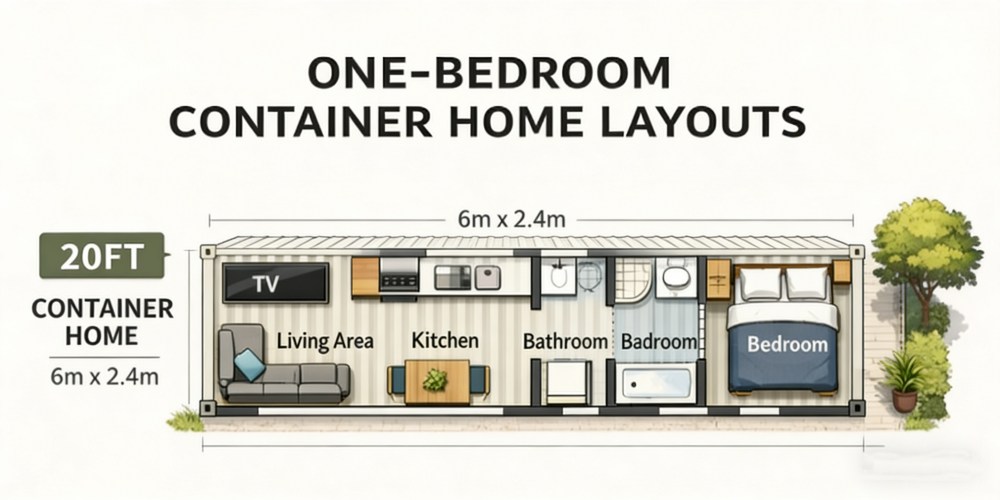
A standard 20-foot container offers a floor area ofapproximately 15 square meters(161 sq ft).Some manufacturers utilize expandable structures to increase the floor area to around 30 square meters(323 sq ft),though the overall living space remains somewhat limited.The typical market price for a 20-foot one-bedroom container home generally ranges from$10,000 to$20,000.The design of a 20ft one-bedroom container home features an integrated layout;upon entering,you will find that the bedroom,living room,and kitchen essentially occupy a single shared space.While this layout meets basic living requirements,it lacks distinct physical partitions between the different functional areas.
Due to spatial constraints,the bathroom in this design tends to be quite compact,and you may find it feels slightly cramped during use.Furthermore,available storage space is limited,meaning everyday items can easily spill out into—and clutter—the visible living areas.
Given these spatial limitations,this 20ft container home is not ideal for long-term residency;it is better suited for short-term stays or for individuals working with a limited budget.If you intend to use it as an Airbnb rental or as temporary housing,this size is typically more than adequate.
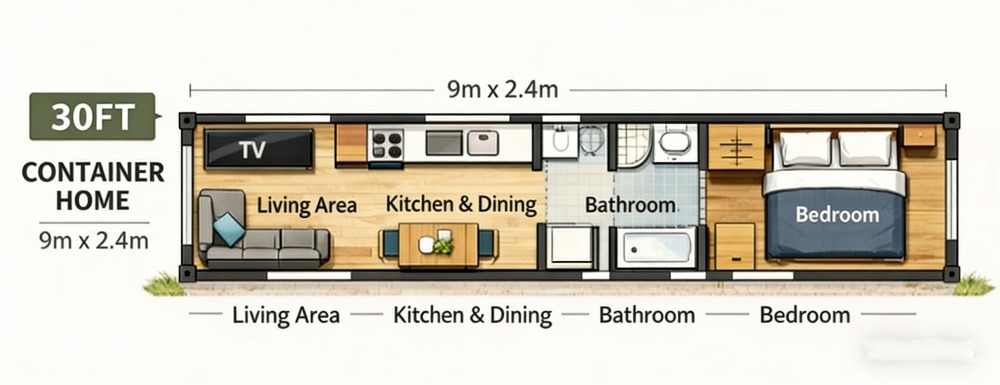
A 30ft expandable container home typically offers a floor area ranging from 40㎡to 60㎡.The market price for a 30ft one-bedroom container home generally falls between$15,000 and$30,000.
Once you step up to the 30ft size,you will notice a significant difference in spatial volume.This larger specification allows for the creation of a"true one-bedroom"layout—moving beyond a mere patchwork of spaces—by enabling you to partition off the bedroom as a separate room.This separation ensures that your rest is undisturbed by activities taking place in the living area.Additionally,the living room and kitchen can be arranged as distinct zones,making daily routines more intuitive and creating a more natural flow throughout the home.
If you plan to reside in the unit for the long term,the 30ft model is a more suitable choice.Living in a space of this size makes it easier to establish clear functional zones,while the privacy afforded by a separate bedroom is a significant advantage.Furthermore,this larger footprint allows for the inclusion of additional storage solutions—such as wardrobes or cabinets—enabling you to stow away daily necessities in an organized manner.This keeps the overall environment looking clean and tidy,bringing it much closer to the feel of a true"home."
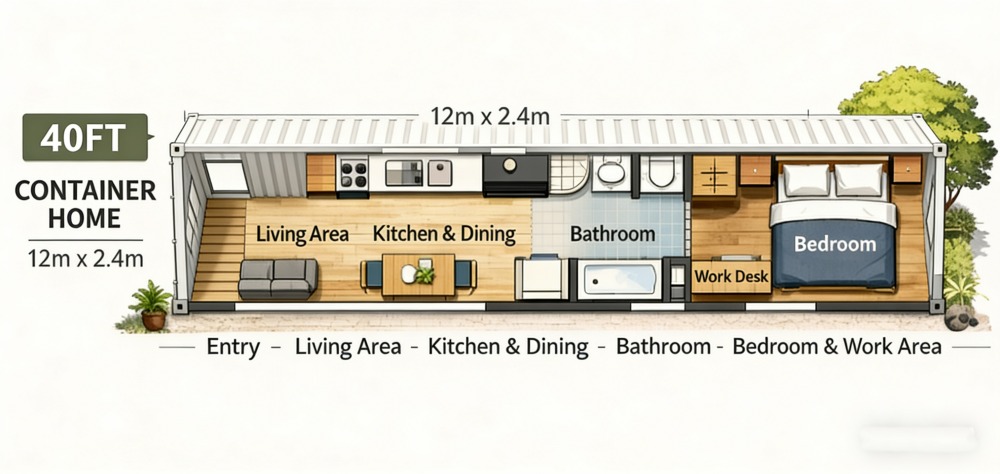
The base floor area of a standard 40ft container is approximately 30㎡.However,by utilizing a"double-expansion"design,the total floor area can be expanded to 60㎡or even larger.The market price for a 40ft one-bedroom container home typically ranges from$25,000 to$50,000+.
A 40ft container home is fully capable of supporting a complete range of residential functions and amenities.Designers typically partition off a separate bedroom area while reserving a relatively spacious living room zone,which you can use to accommodate everyday furnishings such as sofas and dining tables.
The kitchen area can also be fully equipped to meet daily cooking requirements.Furthermore,the dimensions and layout of the bathroom will more closely align with standard residential norms—moving away from cramped or awkward configurations—and can even be designed with a distinct separation between wet and dry zones.
Opting for a 40-foot container home makes it entirely suitable as a long-term living space—for instance,you could place it in your backyard to serve as a"granny flat."Its spatial dimensions closely approximate those of a standard small apartment,ensuring a living experience that feels both natural and comfortable.
Size establishes the baseline price,but when you begin comparing different proposals in earnest,you will discover that price discrepancies often stem from the details.Some homes may appear to have similar quoted prices,yet the actual deliverables differ significantly—a distinction that becomes particularly evident when examining the specific features and specifications included.
If the home comes complete with flooring,cabinetry,bathroom fixtures,and basic furnishings,it is essentially move-in ready.Such comprehensive interior finishing typically adds an extra$3,000 to$10,000 to the cost,depending on the materials selected and the standard of the finishes.
Conversely,if you opt for a"shell"(unfinished)or a minimally finished version,the upfront cost will be lower;however,you will likely need to invest a substantial sum in subsequent renovation work.
Some lower-priced products do not include a complete installation of plumbing and electrical systems—such as water supply and drainage lines,electrical wiring,or power distribution panels.If you undertake this work separately after delivery,these costs typically range from$2,000 to$8,000,depending on the complexity of the installation and local labor rates.
If you wish to have your home fully operational as soon as it arrives on-site,choosing a unit with pre-installed plumbing and electrical systems offers a much more hassle-free solution.
Insulation requirements vary significantly by region;for instance,cold climates demand higher-grade insulation materials,while hot climates prioritize heat-blocking properties.
Upgrading the insulation system typically adds approximately$1,500 to$5,000 to the cost;however,during actual occupancy,you will notice a marked improvement in indoor temperature stability and energy efficiency.
Many people fail to factor these costs into their budget during the initial planning stages.Shipping costs typically range from$1,000 to$5,000,depending on the distance and the mode of transport.If on-site hoisting or foundation installation is required,these additional costs generally add another$2,000 to$6,000 to the total.When these various fees are added together,your overall budget can easily end up significantly higher than the initial product quotation.
Once you take all these factors into account,you will gain a much clearer understanding of why there can be such a vast difference in price for what appears to be the exact same one-bedroom container home.
How to choose the right size container house? When deciding between different sizes,it is easy to focus your attention solely on the upfront price.However,in practice,you will discover that the actual living experience is often far more important than the cost—especially if you intend to live in the space for several years rather than just a few months.
If your intended use scenario is short-term—such as on-site worker accommodation,temporary housing,or an Airbnb rental—then a 20ft unit is sufficient to meet your basic needs.Within this space,you can comfortably handle sleeping,simple cooking,and daily living activities,though the overall layout will feel quite compact.
If your budget falls roughly between$10,000 and$20,000,a 20ft container home is typically the most accessible and affordable option.However,as you continue to use the space over time,you will likely begin to feel the limitations imposed by its size.
When you begin to consider long-term residency,your requirements for living space will naturally increase;in this context,a 30ft unit becomes a much more sensible choice.With this size,you can enjoy a separate,private bedroom,while also keeping the living room and kitchen distinct from one another,creating a space with a much more layered and organized feel.
Living in such an environment makes it easier to establish a regular daily routine without feeling the discomfort often associated with cramped quarters.Most users with a budget between$15,000 and$30,000 tend to gravitate toward the 30ft container home,as it strikes a natural and effective balance between cost-efficiency and living comfort.
If you have higher standards for your living environment—or if you intend for this space to serve as your primary residence for the long haul—then the 40ft container home is the option best suited to your needs.Within this size range,you can achieve a more comprehensive functional layout—featuring,for instance,a more spacious living room,a more efficiently designed kitchen,and a bathroom that approximates the dimensions of a standard residential bathroom.
When living in such a space over the long term,you will distinctly perceive that the gap between it and a conventional home has been significantly narrowed.The budget for a 40-foot container home typically ranges from$25,000 to$50,000—or even higher—yet what you gain is a more stable and comfortable living experience.
Before making a final decision,you may find yourself repeatedly asking:is this type of housing truly a worthwhile investment?
From a cost perspective,container homes certainly possess distinct advantages.With a more manageable budget,you can acquire a complete living space without incurring the high construction costs typically associated with traditional housing.In terms of construction timelines,they are also highly efficient;you can typically take delivery of the finished unit and begin using it in a much shorter timeframe.
However,you must also acknowledge their limitations.Space remains an inherent constraint—a limitation that becomes particularly pronounced with 20-foot units or smaller sizes.Additionally,varying regional regulations and permitting requirements may influence whether you can successfully utilize this type of housing in your specific location.
When weighing all these factors collectively,you will realize that the critical question is not simply"Is it worth it?"but rather,"Is it the right fit for*you*?"If your requirements are clearly defined—for instance,if you have a limited budget,need a solution implemented quickly,or desire a flexible housing arrangement—then a container home presents a highly attractive option.
As you compare various sizes and configurations,you may discover that standard off-the-shelf products do not always align perfectly with your specific needs.You might desire a slightly larger space,or a layout that better accommodates your personal lifestyle and habits.In such instances,partnering with a supplier that offers customization options provides far greater flexibility.
WZHhouse offers a range of standard size options—from 20-foot and 30-foot units to 40-foot units—allowing you to select the solution that best fits your budget and intended use case.If you require housing for only a short duration,you might opt for a compact 20-foot unit;conversely,if you prioritize the overall living experience,you may wish to consider a 30-foot or 40-foot layout to benefit from a more comprehensive and distinct spatial division.
Most importantly,WZHhouse offers on-demand,custom manufacturing services tailored to your exact specifications.Once you have defined your requirements,you can customize the home's interior layout,functional zoning,and amenities.For instance,you might increase storage capacity,optimize the kitchen layout,or enhance insulation standards to suit varying climatic conditions.You can also plan the spatial arrangement more effectively based on the actual number of occupants.
When you opt for this level of customization,you are acquiring more than just a standard product;you are securing a living space that is precisely tailored to your actual lifestyle.This flexibility proves particularly practical—and valuable—for users planning to utilize the home over the long term.
When deciding on a one-bedroom container home,you should not focus solely on the price tag.You must also take into account the intended duration of use,the number of occupants,and your specific lifestyle.
Many of our customers initially select smaller dimensions in an effort to save on their budget;however,once they begin using the space,they quickly find it to be insufficient.
Therefore,if your budget permits,you should prioritize selecting a larger size rather than simply opting for the lowest price point.



Copyright © Hebei Weizhengheng Modular House Technology Co., Ltd. All Rights Reserved
Sitemap





 +8615081877521
 +8615081877521