- icy@wzhgroup.com
- +86 15081877521


In recent years,expandable container houses have seen rapid growth in the global residential and commercial construction sectors.According to data from various international market research firms,the global modular construction market is projected to maintain a compound annual growth rate(CAGR)of approximately 6%to 8%over the coming years,with the potential to exceed$150 billion by around 2030.
China has established itself as a premier global hub for modular construction manufacturing.It produces over 90%of the world's standard shipping containers and possesses a mature supply chain—encompassing steel processing,insulation materials,window and door systems,and modular building components—that provides a solid foundation for the development of expandable container houses.
Thanks to robust manufacturing capabilities and extensive export experience,an increasing number of projects in Australia,the United States,Canada,New Zealand,the UK,and the Middle East are sourcing expandable container houses from China.These units offer foldable transport and rapid installation,and can be customized to meet the specific building standards and climatic conditions of different regions.Consequently,they are widely used in applications ranging from residential homes,"granny flats,"and vacation cottages to construction camps,commercial offices,and public facilities.
If you are interested in learning about Chinese expandable container houses or plan to incorporate them into a project,this article provides a comprehensive overview.We cover how they work,their key advantages,application scenarios,factors influencing price,and tips for selecting a reliable Chinese manufacturer,helping you gain a full understanding of this rapidly evolving modular building product.
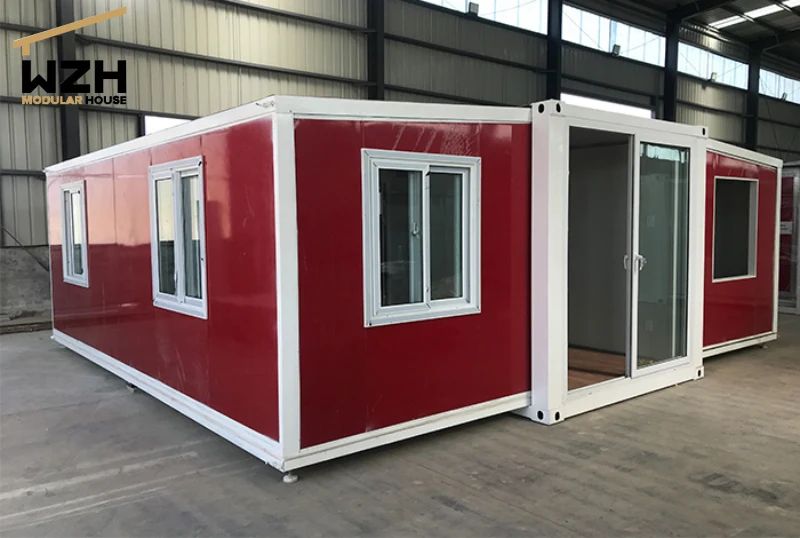
An expandable container house is a type of prefabricated building featuring a modular design.It remains folded during transport;upon arrival at the site,the side structures are unfolded,quickly transforming the compact shipping dimensions into a spacious living area.Compared to standard container houses,this design significantly increases usable interior space while maintaining the convenience of easy transport,garnering widespread attention in the global market.
Visually,an expandable container house closely resembles a standard shipping container,but the fundamental difference lies in their structural design.
Standard shipping containers have fixed dimensions,meaning their size remains essentially the same whether in transit or in use.Expandable container houses are designed with folding and unfolding capabilities from the outset.The main structure utilizes high-strength steel connections,allowing modules on both sides to unfold outward upon arrival at the site,thereby increasing the floor area by approximately two to three times.
The unfolding process generally does not require complex construction work.For standard models,once the foundation is prepared,a team of two to four workers can typically complete the unfolding and securing of the main structure within two to six hours,significantly reducing on-site installation time.
This design not only enhances construction efficiency but also lowers transportation costs,making it particularly suitable for residential and commercial projects requiring rapid deployment.
While structural details may vary among manufacturers,modern expandable container houses typically consist of the following core systems.
First is the main steel structure,which bears the load and ensures the stability of the entire building;it is also a critical factor in the house's durability.High-quality products often utilize hot-dip galvanized steel or high-strength steel structures to enhance corrosion resistance and extend service life.
The wall system generally comprises exterior wall panels,insulation layers,and interior finish panels.Depending on the project's climate,various insulation materials—such as rock wool,polyurethane,or glass wool—can be selected to meet thermal insulation,fire safety,and energy efficiency requirements.
In addition,the roofing system,doors and windows,electrical wiring,lighting,kitchen and bathroom facilities,and plumbing systems are usually pre-installed in the factory.This means that once the product arrives on-site,it requires only simple connections to become operational,thereby minimizing on-site construction work.
To meet diverse project needs,the market for expandable container houses has developed a comprehensive range of specifications,with 20-foot,30-foot,and 40-foot units being the most common sizes.
| Size | Approx. Expanded Area | Typical Layout | Suitable Applications |
|---|---|---|---|
| 20 ft | ~37 m² | 1 Bedroom + 1 Living Room | Offices, single-occupancy homes, guardhouses |
| 30 ft | ~55 m² | 2 Bedrooms + 1 Living Room | Family homes, granny flats, vacation homes |
| 40 ft | ~74 m² | 2–3 Bedrooms | Long-term residences, commercial projects, staff dormitories |
In addition to standard sizes,an increasing number of manufacturers also offer customized designs.For instance,the length of the unit can be adjusted,terraces or balconies added,and interior layouts optimized—or even multiple units combined to create larger spaces—to meet the specific requirements of various projects.
China is not only one of the world's largest production bases for container houses but also a leader in the rapid development of prefabricated construction technology.A comprehensive supply chain,mature manufacturing expertise,and flexible customization capabilities make Chinese-made expandable container houses highly competitive in the international market.
China possesses a mature industrial chain covering steel structures,building materials,and modular construction,allowing most components to be manufactured locally.
This industrial advantage boosts production efficiency and ensures compatibility between different components.From steel structure fabrication and wall panel production to the installation of doors,windows,sanitary facilities,and electrical systems,most processes can be completed within a single factory,thereby enhancing overall product quality.
For export projects,centralized production also shortens procurement cycles and improves delivery efficiency.
Different countries have varying requirements regarding building codes,climatic conditions,and lifestyle habits;consequently,standardized products often cannot meet the needs of every project.
For example,products exported to Australia typically require enhanced roof insulation,anti-corrosion treatments,and superior wind resistance;exports to Northern Europe prioritize thermal insulation,while the Middle East market places greater emphasis on heat insulation capabilities.
Established Chinese manufacturers can adjust wall thickness,door and window configurations,electrical standards,and interior layouts based on the project location,ensuring the product aligns with local usage requirements.
As the global market for prefabricated buildings continues to grow,Chinese expandable container house manufacturers have accumulated extensive experience with overseas projects.
Whether for residential,educational,medical,construction camp,or commercial office projects,they can provide design and production solutions tailored to the specific requirements of different countries.Furthermore,mature export processes and international logistics systems streamline the entire procurement journey.
For clients importing prefabricated houses for the first time,partnering with a manufacturer that has extensive export experience can reduce communication costs and improve overall delivery efficiency.
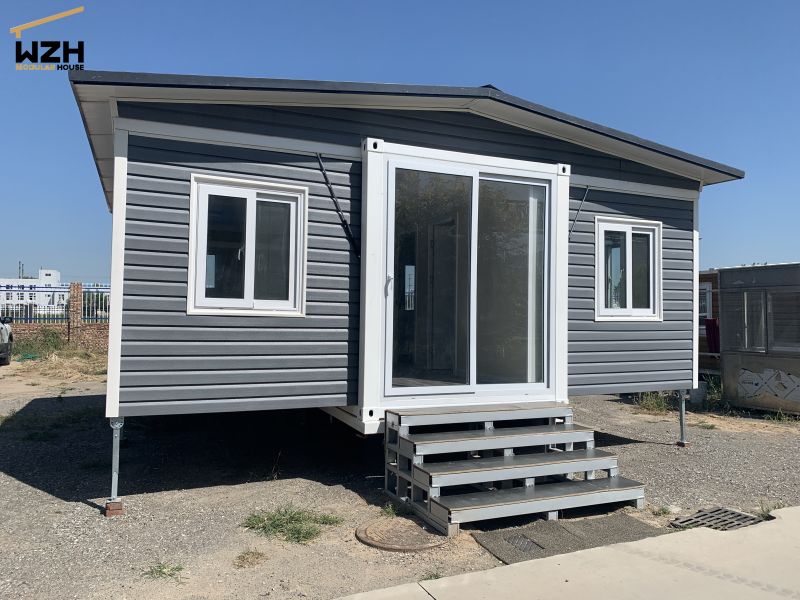
Compared to traditional buildings and standard container homes,the greatest advantages of expandable container houses lie in their efficient transport,rapid installation,and flexible spatial configuration,all while meeting a wide range of architectural needs.Consequently,they are increasingly becoming a popular building solution for residential,commercial,and engineering projects.
Traditional construction often involves multiple stages—such as foundation work,structural assembly,and interior finishing—with a project cycle that can last months or even longer.
Expandable container houses are different.Since the main structure,walls,doors,windows,and most interior finishes are completed in the factory,on-site work is primarily limited to unfolding,securing,and connecting utilities.
For standard units,the main structure can usually be installed within 2 to 6 hours,significantly shortening the project delivery time compared to traditional construction methods.This advantage is particularly valuable for residential projects with tight schedules,emergency housing,or engineering camps.
Transportation costs have always been a significant component of international construction projects.
Standard container homes have fixed dimensions,meaning one shipping container typically transports only a single building unit.In contrast,expandable container houses feature a foldable design that allows for a more compact transport configuration,thereby increasing loading efficiency.
For projects requiring bulk procurement,this design not only lowers ocean freight charges but also reduces handling and storage costs,offering a distinct advantage in international shipping.
Modern expandable container houses are no longer limited to simple one-bedroom designs;layouts can be configured with one,two,or even three bedrooms to suit specific project requirements.
Beyond residential use,they can serve as offices,vacation rentals,medical stations,retail shops,cafés,visitor centers,and engineering camps.Multiple modules can also be combined to create larger spaces,opening up new possibilities for commercial and public architecture.
While expandable container houses offer advantages such as rapid installation,low transport costs,and high space efficiency,they are not suitable for every project.Key factors to consider include local building codes,foundation requirements,transportation conditions,and dimensional limitations.If these issues are thoroughly addressed during the planning phase,most can be resolved through smart design and construction.
Many people assume that as long as a house can be transported to the site,it is ready for immediate installation and use.In reality,most countries have distinct approval requirements for permanent,temporary,and commercial structures.
Take Australia,for example:approval processes,foundation requirements,and building codes for residential projects can vary significantly between states and local councils.If you plan to use an expandable container house as a long-term residence,it is advisable to verify local building permits,structural requirements,and utility connection standards at the very beginning of the project.
Completing this preparatory work in advance helps avoid design revisions or rework later on,thereby saving both time and money.
Although expandable container houses are prefabricated structures,they cannot simply be placed on just any ground surface.
For long-term residential or commercial buildings,support systems—such as concrete slabs,strip foundations,or helical piles—must be designed based on geological conditions to ensure overall stability.
If the unit is intended for temporary use,such as an office,construction camp,or exhibition structure,foundation requirements are simpler;however,the ground must still be level,and the structure securely anchored.
While the expandable design effectively reduces transport volume,large-scale projects still require advance planning regarding transport routes,loading/unloading equipment,and on-site lifting conditions.
For instance,projects in remote mountainous areas,on islands,or in locations with restricted road access may require transport plans tailored to specific site conditions.Consequently,developing a logistics plan concurrently with the production phase often minimizes waiting times and boosts overall delivery efficiency.
As product designs continue to evolve,the applications for expandable container houses have expanded far beyond traditional temporary structures.From residential and commercial uses to public facilities and engineering projects,they are emerging as a highly flexible architectural solution.
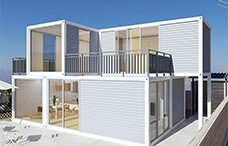
In recent years,an increasing number of households have adopted expandable container houses as permanent residences or backyard dwellings(granny flats).
Compared to traditional housing,these units offer shorter construction times and support layouts ranging from one to three bedrooms,making them ideal for home extensions,independent living spaces,or rental properties.
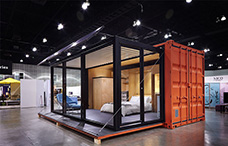
For rural tourism,campsites,and eco-resorts,expandable container houses offer rapid installation alongside increasingly modern aesthetic designs.By incorporating features such as terraces,floor-to-ceiling windows,and wood accents,these units create a comfortable living environment while minimizing the impact of on-site construction on the natural surroundings;consequently,they are increasingly used in tourism projects.
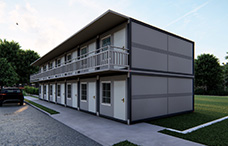
Large-scale infrastructure and mining projects often require the rapid setup of extensive dormitory,office,and communal facilities.
Expandable container houses are easy to transport and quick to install;furthermore,they can be dismantled and relocated after a project concludes,offering high reuse value.
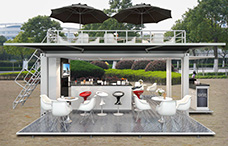
Beyond residential use,expandable container houses are widely utilized for cafés,retail stores,showrooms,medical stations,schools,and temporary office buildings.
Multiple modules can be combined to create larger commercial spaces,offering flexible architectural solutions for startups and public service facilities.
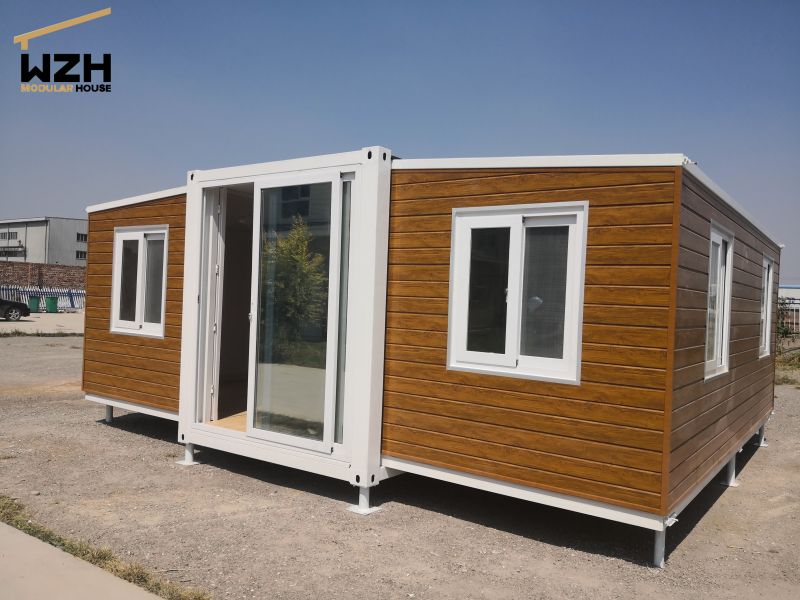
There is no single standard price for expandable container houses;costs vary based on factors such as size,configuration,materials,insulation ratings,and shipping methods.Therefore,when comparing quotes,it is advisable to consider the overall configuration rather than focusing solely on the unit price.
Below are approximate reference prices for common products in the international market.
| Size | Approx. Expanded Area | Typical Layout | Suitable Applications |
|---|---|---|---|
| 20 ft | ~37 m² | 1 Bedroom + 1 Living Room | Offices, single-occupancy homes, guardhouses |
| 30 ft | ~55 m² | 2 Bedrooms + 1 Living Room | Family homes, granny flats, vacation homes |
| 40 ft | ~74 m² | 2–3 Bedrooms | Long-term residences, commercial projects, staff dormitories |
Note:The prices above are for reference only;actual quotes will vary based on configuration,quantity,shipping destination,and customization requirements.
In addition to the size of the house,factors such as wall insulation materials,door and window brands,kitchen and bathroom fittings,electrical systems,and exterior wall finishes all influence the final price.
Furthermore,costs associated with international shipping,customs clearance at the destination port,local transport,and on-site installation must also be factored into the overall budget.For overseas projects,the total cost provides a more meaningful reference than the ex-factory price alone.
China has established a mature process for exporting expandable container houses.From initial design to international shipping,most projects follow standardized procedures;provided there is thorough communication during the preliminary stages,overall delivery efficiency is typically high.
Typical Export Process
Requirement Discussion
↓
Design&Quotation
↓
Contract Confirmation
↓
Factory Production
↓
Quality Inspection
↓
Container Loading&Shipment
↓
International Sea Freight
↓
Customs Clearance at Destination
↓
On-site Installation
Generally,the production cycle takes approximately 25 to 45 days,while sea freight takes 15 to 35 days,depending on the destination port.The entire project—from order placement to the completion of on-site installation—usually takes about 2 to 3 months.
As a professional container house manufacturer of modular buildings,WZHhouse specializes in the R&D and production of expandable container houses,foldable container houses,modular homes,and customized prefabricated buildings.
We possess a mature steel structure manufacturing system and extensive international export experience.We offer customized design,manufacturing,quality control,and international logistics support tailored to the building requirements of different countries and regions.
Whether for residential homes,granny flats,tourism and vacation projects,construction camps,or commercial buildings,WZHhouse is committed to providing efficient,reliable,one-stop building solutions through high-quality products and professional services.
Expandable container houses are not merely innovative building products;they represent the future direction of modern modular construction.By combining foldable transport,rapid installation,flexible layouts,and factory prefabrication,they offer broad application prospects across residential,commercial,tourism,construction camp,and public facility sectors.
As global demand for efficient,sustainable buildings grows,Chinese-made expandable container houses are becoming a preferred choice for an increasing number of international projects,thanks to mature supply chains,consistent product quality,and extensive export experience.If you are planning a project involving a residence,granny flat,vacation home,or commercial building,it is advisable to fully understand local building requirements before making a purchase and to select a professional manufacturer with international project experience.Doing so ensures you obtain products that better meet your project's needs and facilitates a smoother,more efficient process—from design and production to delivery—thereby laying a solid foundation for long-term use.



Copyright © Hebei Weizhengheng Modular House Technology Co., Ltd. All Rights Reserved
Sitemap



 +8615081877521
 +8615081877521