- icy@wzhgroup.com
- +86 15081877521


When you start thinking about building a house using shipping containers,you’re often not attracted to just the appearance.More commonly,some practical concerns arise,such as:whether it is comfortable to live in,whether the problem of cold winter and hot summer can be solved,whether the overall cost is low or higher,and whether this kind of house is really suitable for long-term living.These issues often directly affect the final decision.
At the same time,the effects of container houses on the Internet are often biased toward"idealization":industrial style design,rapid construction,and modular expansion,which look modern and efficient.However,in the actual implementation process,factors such as heat insulation,space utilization,structural modification,and later maintenance will make the experience different from the imagination.
Therefore,before you really decide whether to use shipping containers to build a house,it is more important to start from the real use scenario and fully understand its advantages and disadvantages,so as to judge whether it meets your budget,lifestyle and long-term living needs.
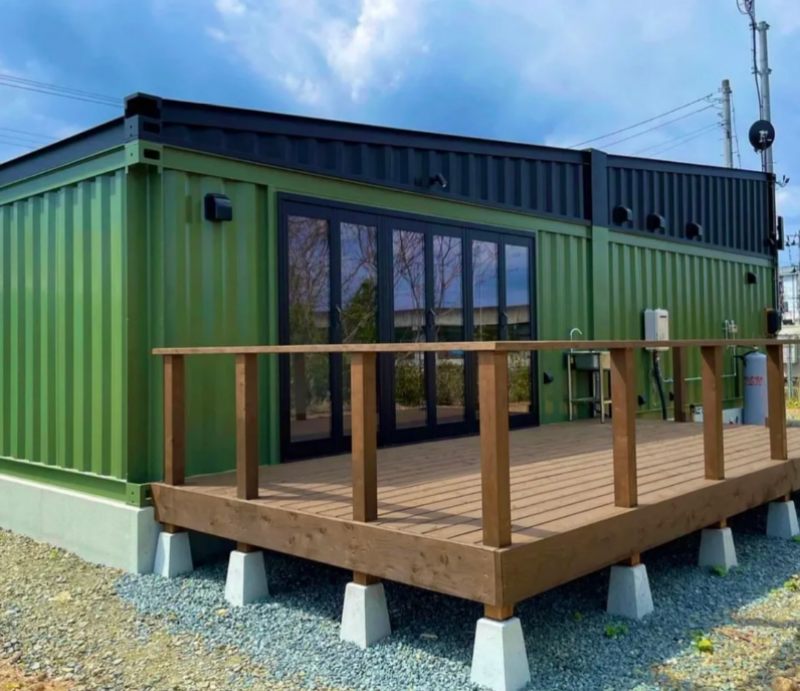
The advantages of shipping container house mainly include construction efficiency,structural strength,and design flexibility.Most components can be prefabricated in the factory,and on-site work is mainly lifting and connection,which greatly reduces build time.
It also offers flexible budgeting and easy expansion,making it suitable for vacation homes,temporary housing,and rental projects like Airbnb.
Traditional houses often take several months from foundation construction to main body completion,and may be delayed by weather,labor and material supply.
In contrast,the container itself is a complete structural unit,and many processes can be completed in advance at the factory,such as door and window openings,water and electricity pre-embedding and even basic decoration.After being transported to the site,only hoisting and foundation connections are required to quickly enter the use stage.
This speed advantage is particularly evident in some vacation home or temporary housing projects.For example,when building a cabin by a lake or in a mountainous area,if you use traditional methods,you may miss the best use season.
The use of container modular construction can significantly shorten the waiting time and allow the project to be launched faster.For areas with limited construction conditions or remote locations,reduced on-site work time also means lower overall costs.
Many people first come into contact with container housing because it seems"cheaper".As the main structure,second-hand containers can indeed reduce some material costs,and the basic construction is also relatively simple.
For users with limited funds,they can build a basic living unit first and then gradually expand the space.
This staged construction method is not common in traditional houses,but it is very flexible in the container system.
For example,first use a 20-foot or 40-foot container house as a living space,and then add modules according to family changes.
However,it should be noted that the overall cost does not equal"low price".When it comes to insulation,water and electrical systems,door and window modifications,and interior renovations,costs can rise significantly.
So a more accurate understanding is:the budget structure is more flexible,rather than absolutely cheaper.
The container itself is designed for shipping and needs to withstand long-distance transportation,stacking pressure and complex sea conditions,so the strength of the steel structure itself is relatively high.After being properly designed and reinforced,it performs well in terms of wind resistance and overall stability.
In coastal areas or environments with strong winds,some projects will choose containers as the main structure to improve the overall stability of the building.In seismic zone areas,as long as the structure design is reasonable,it can also have certain safety advantages.
But it needs to be emphasized that this strength is based on the premise of"integrity of the overall structure".If you cut the wall at will or add large-area windows,the stress system may be damaged,thereby reducing safety.
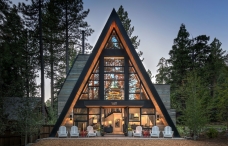
Container homes have distinct visual characteristics of industrial style,which makes them easier to identify among many architectural forms.On social media and short-term rental platforms,this differentiated appearance often brings higher attention.
Many B&B projects choose containers not just because of cost,but because of their“transmissibility.”
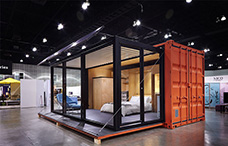
The combination of black steel structure,large area ofglass,roof terrace and other design elements can easily form a strong visual memory.
For Airbnb or the vacation rental market,this appearance advantage can directly impact click-through rates and occupancy rates.But if we go back to the perspective of long-term residence,visual appeal is just added value,and comfort is the core.
One of the biggest features of container homes is that they can be combined and expanded like"building blocks".This structure provides greater flexibility for families whose future needs are uncertain.
For example,in the early stage,only a small space is needed to live in.Later,as the family members increase,new modules can be added or expanded.Different functional areas can also be set up independently,such as bedrooms,living rooms or office spaces.
This kind of expansion often requires large-scale construction in traditional buildings,but container structures can be adjusted relatively quickly.However,as the number of modules increases,the overall design complexity and cost will also increase simultaneously.
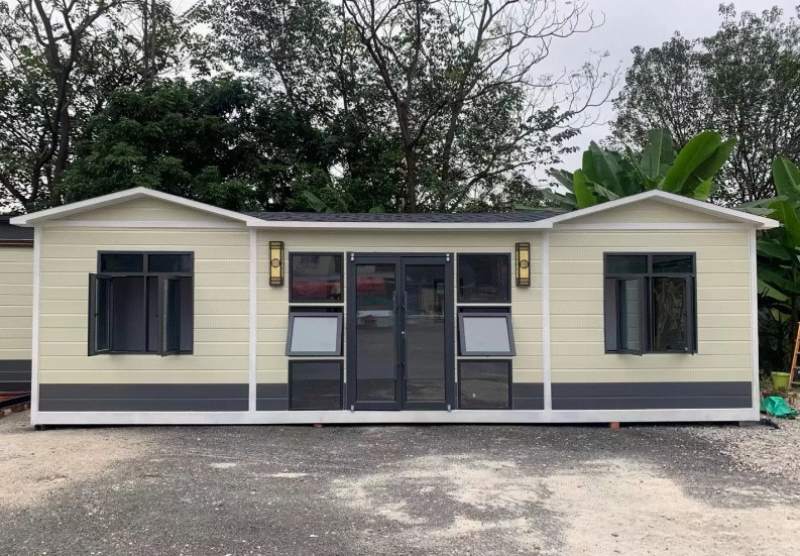
Overall,the challenges of container housing mainly focus on three aspects:living comfort,difficulty of structural modification,and long-term maintenance costs.It does have the advantages of flexibility and unique shape,but when it is actually implemented,the requirements for design and construction will be higher.Many questions are not"whether it is available",but"how bad the effect is",which ultimately directly affects whether you live comfortably and spend a lot of money.
The following points are critical practical considerations before deciding to build a house in a container.
The main body of the container is made of steel,which conducts heat very quickly.When the weather is hot,the indoor temperature rises quickly;when the weather is cold,the heat cannot be retained,and the difference in body sensation will be obvious.
If there is no complete insulation treatment,it will feel stuffy in summer and cold in winter,which will affect the comfort of daily life.Like some hot areas in the southern United States,it is difficult to stay with people for long periods of time during the day in a container house without optimized insulation.
If you want to live more comfortably,you can add insulation,ventilation systems,and double-glazing to your container house to improve the environment.
These modifications can indeed improve the experience,but the cost will also go up.If you do not calculate clearly in the early stage,it is easy to have a large gap between the budget and the actual situation.
Many people will initially think that building a house in a container is just"buying a box and decorating it",and the process should be relatively simple.Only when you really start to do it will you find that as long as it involves opening windows,cutting structures,or splicing multiple boxes,you need to redesign the structural reinforcement design.
Water and electricity wiring,waterproofing,drainage systems,as well as air conditioning and ventilation,these basic parts need to be re-planned.These contents are often the bulk of the money,not the container itself.
Add to this the costs of transportation,hoisting,foundation construction,and local approvals,and it doesn’t add up to an easy task.In some areas,the process is quite complicated and even takes longer than traditional houses.
Calculated as a whole,the final total cost is often not as big as expected from ordinary housing.
The width and height of standard containers are inherently limited.No matter how well the design is done,the sense of space will still be limited.
The model house may look good,but after you actually live in it for a while,your feelings will change.
Especially when there are more family members,problems will become more obvious,such as insufficient storage,difficulty in moving around,and insufficient privacy space.Furniture also needs to be made according to size,otherwise it will easily look cramped.
Many projects will choose to splice multiple containers to expand space.The space is larger,but the construction difficulty and overall cost will also increase.
Containers are steel structures and are prone to condensation when exposed to humid conditions.Over time,the walls may become moldy and the metal may begin to corrode.This situation is more common if you are at the beach or in a place with a large temperature difference.
If the protection is not enough,problems such as paint peeling and roof water seepage may occur.These changes will not appear all at once,but will accumulate slowly.
Therefore,container housing is not a"install it and forget about it"type.In the later stage,anti-corrosion treatment,waterproof inspection,and structural maintenance will still need to be carried out regularly.This part is also part of the long-term cost.
Container housing is not a"suitable for everyone"solution.It is more suitable for some people with specific lifestyles or usage scenarios.Its advantages are flexibility,fast construction speed,and strong sense of design,but to truly live comfortably,a clearer matching of needs is often required.
If your needs fall in the following directions,container housing will be a more attractive choice.
The most intuitive feature of container houses is that their appearance is very recognizable.Steel structure,simple lines,and open space can easily form an industrial or minimalist style.
If you like this kind of design-oriented and personalized architectural style,then it will be easier for container houses to achieve the desired effect.Whether it is a large area of glass or a terrace design,it can enhance the overall visual experience.
In some projects with tight time requirements,the advantages of container housing will be more obvious.Such as temporary housing,transitional housing,or space that needs to be put into use as soon as possible.
Because the main structure has already been formed,a lot of construction can be completed in advance at the factory.On-site assembly and foundation connections are mainly done,and the overall cycle will be much shorter.This is crucial for those who are in a hurry.
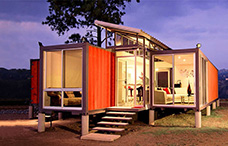
For those who do short-term rentals or homestays,the appeal of container homes comes more from"differentiation."The appearance is unique,the photo effect is good,and it is easier to attract clicks on the platform.
Many popular Airbnb projects use containers to build mountain view houses,seaside huts or forest vacation houses,using visual experience to enhance competitiveness.This model is more focused on“content-based real estate”rather than just living space.
Some people who pursue an independent lifestyle,such as those who want to stay away from the city and achieve basic self-sufficiency,will also consider container housing.
It can be combined with solar energy systems,rainwater collection and other solutions to form a relatively independent living space.In remote areas or natural environments,this combination will be more practical.
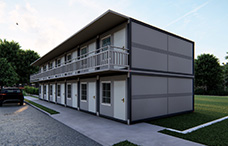
Container housing is often used in construction site dormitories,temporary offices or project sites.
The reason is very straightforward,that is,it is fast to build,movable,and has a stable structure.
This type of demand usually does not pursue long-term complex decoration,but focuses more on functional integrity and deployment efficiency,so containers will be more suitable.
With the popularity of remote working,some people will choose to create a"work+living"space in the suburbs or natural environment.
Container houses can be made into independent studios or small holiday offices,which not only provide a certain degree of privacy,but also can quickly build a relatively complete living environment.
This mode will have some appeal for those looking to switch between city and nature.
Shipping container homes are attracting more and more attention not only because of shipping container house cost and appearance,but more importantly because of their advantages in construction speed,modular flexibility,and design adaptability.It is particularly suitable for scenarios such as B&Bs,vacation homes,short-term rentals(such as Airbnb),and remote office spaces that require rapid implementation and scalability.
Generally speaking,shipping container housing is more suitable for those who value flexibility and rapid construction rather than traditional long-term fixed housing,such as investors,developers or users looking for innovative living styles.With proper planning and professional design,it can be an efficient and practical residential solution.
If you are considering a container home project,WZHhouse can provide you with a one-stop modular building solution from feasibility assessment,custom design to overall delivery.Feel free to click for consultation at any time to communicate with our professional team about your project needs and obtain more detailed plans and quotation support.



Copyright © Hebei Weizhengheng Modular House Technology Co., Ltd. All Rights Reserved
Sitemap

 +8615081877521
 +8615081877521