- icy@wzhgroup.com
- +86 15081877521


Yes,a shipping container home can potentially serve as an ADU(Accessory Dwelling Unit)in a California backyard;however,you cannot simply place a container in the yard and treat it as a legal residence.The specific lot,site layout,architectural design,utility connections,and the approval process must all comply with applicable requirements.
It is important to distinguish between two concepts:a"container home"refers to a building product or construction method,whereas an"ADU"refers to a residential use classification.The California Department of Housing and Community Development https://www.hcd.ca.gov/(HCD)defines an ADU as an accessory dwelling unit with complete independent living facilities,including areas for living,sleeping,dining,cooking,and sanitation.
A detached ADU is built separately from the primary residence and is the type typically considered when placing a standalone structure in a backyard.
If you are considering building a container ADU,the key question is not simply whether California permits the use of shipping containers,but rather whether your property is eligible for an ADU and whether the planned container home meets all relevant state and local requirements.
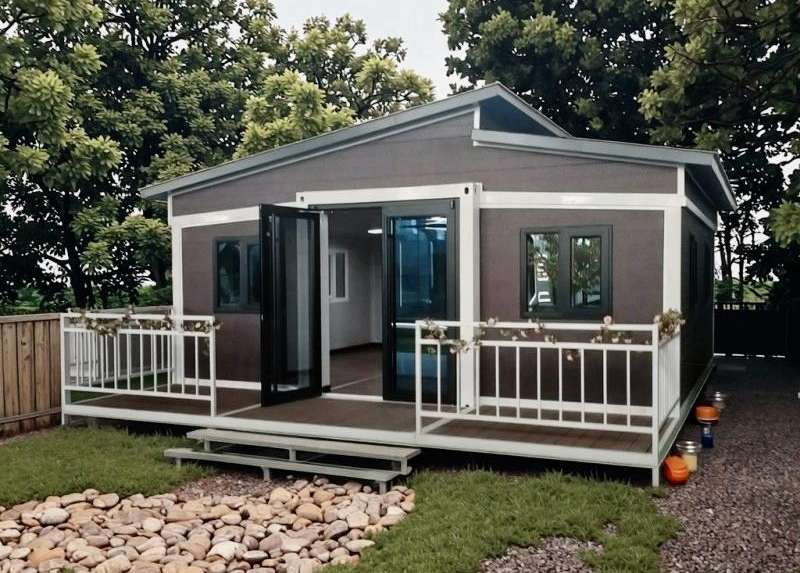
California regulations do not prohibit the use of container-based structures as ADUs simply because they utilize a shipping container framework.However,the completed structure must function as a residence and satisfy all requirements applicable to ADUs and the specific property.
For instance,you could convert a 40-foot shipping container into a home featuring a bedroom,kitchen,bathroom,and living area.While it may function as a complete small home from a product standpoint,regulatory authorities must still review and approve it as a residential building project,rather than viewing it merely as a container placed on private land.
This is particularly important if you are sourcing the unit from an overseas manufacturer.While the factory may complete the structural work,interior finishes,doors,windows,kitchen,and bathroom installations prior to shipment,this does not mean the home automatically receives ADU approval upon arrival in California.
The California Department of Housing and Community Development(HCD)is responsible for providing statewide ADU policies and related information.The department updated the ADU Handbook in March 2026 to reflect changes in state law effective January 1,2026.Specific projects still require approval from local government agencies in accordance with applicable requirements.
What determines whether a container home can serve as an ADU is not its structural type,but whether it possesses the functionality for independent living once completed.
This generally means the unit must include adequate living space,a sleeping area,cooking facilities,and sanitary facilities.Official documentation from the California HCD lists complete independent living facilities as a key component of the ADU definition and outlines common forms,such as detached,attached,and converted-space ADUs.(HCD:ADU Regulations)
This is why a standard construction site office or an empty shipping container cannot simply be used as a residential ADU.If you plan to use it for long-term habitation,you must address factors such as insulation,ventilation,electrical systems,plumbing,structural safety,and emergency egress.
For container ADUs,it is best to plan for residential use from the initial design stage.Rather than adding living amenities after production is complete,it is preferable to integrate the structure,door and window openings,insulation,and electrical and plumbing systems into the overall design from the start.
Before selecting a container model,you need to understand the specific conditions of the lot.Even if a backyard appears spacious,a detached ADU may not necessarily meet all applicable requirements.
The first step is to verify the zoning designation and local regulations to ensure ADU construction is permitted.While California has statewide ADU laws,individual cities and counties may also establish local ordinances and objective development standards that comply with state law.The HCD notes that local standards may cover building height,setbacks,unit size,lot coverage,and other development conditions,provided they align with state ADU laws.(HCD:ADU Approval and Implementation)
The actual layout of the lot is equally important.You need to consider the relationship between the planned ADU and the primary residence,property lines,existing accessory structures,access paths,and utility connections.
For container homes,transportation and installation logistics must also be considered in advance.While a unit might fit in the backyard on paper,actual construction could still face difficulties if trucks,cranes,or other installation equipment cannot easily access the site.This is a matter of site planning,not just the dimensions of the house itself.
Setbacks are a key factor to verify before determining the placement of the structure.
Under current California ADU regulations,local governments generally cannot require setbacks exceeding 4 feet from side and rear property lines for attached or detached ADUs that comply with relevant state statutes.However,applicability depends on the specific project,and exceptions may exist;properties located in coastal zones may also be subject to additional requirements.(HCD:2026 ADU Handbook)
This does not mean that every container ADU in California can simply be placed 4 feet from the property line.Front yard setbacks,local planning conditions,special zone regulations,and specific site conditions must still be verified on a case-by-case basis.
A practical approach is to first identify the area of the backyard that is truly buildable.Once you understand the applicable setback requirements,the location of the primary residence,and existing structures and access conditions,you can determine whether a 20-foot,40-foot,or expandable container home is suitable for the site.
Detached container ADUs are typically situated separately from the primary residence,though the specific location depends on the lot layout.
There may be multiple potential locations in the backyard,each with its own set of constraints.For example,placing the unit near the side or rear property line might help preserve open space elsewhere on the lot,whereas placing it closer to the primary residence could facilitate easier utility connections(such as water and electricity).Existing features such as garages,fences,trees,swimming pools,and other structures may also impact the available space.
Access routes must not be overlooked either.Beyond the access needed for daily living,one must consider the logistics of transporting and installing the unit,utility connections,and future maintenance access.
Therefore,it is advisable to provide the manufacturer with basic site information before finalizing the product.A simple site plan,backyard dimensions,and on-site photos can help identify issues early on—problems that might be difficult to spot based solely on the container's dimensions.
Once site conditions are confirmed,the next step is to verify whether the container home itself meets applicable building requirements.
Converting a shipping container into a residence often involves significant structural changes.Creating large windows,sliding doors,or open-concept layouts may require cutting openings into the original steel walls,which can affect structural integrity.
Designs must account for local load and structural requirements,including foundations,roof and floor loads,wind loads,seismic standards,and structural connections.Large door or window openings may necessitate structural reinforcement.
Consequently,the standard container drawings provided by manufacturers may not suffice for project approval.The final design may require review or adjustment by qualified professionals tailored to the specific project.
Residential ADUs must also comply with applicable fire and life safety codes.Depending on the final design and relevant regulations,requirements may cover emergency exits,doors and windows,smoke and carbon monoxide detectors,fire separation,and necessary fire-resistant construction.
Specific requirements depend on the home's design and site conditions.It is best to incorporate fire safety measures during the design phase rather than attempting to retrofit them after production is complete.
Container ADUs require properly designed electrical and plumbing systems;simply installing a few household appliances inside does not constitute a fully equipped residence.
Electrical design may encompass power supply connections,distribution panels,wiring,and lighting,as well as dedicated circuits for kitchen,bathroom,and HVAC equipment.Plumbing design must account for water supply,drainage,sanitary fixtures,and hot water systems.
If the house is manufactured overseas,it is advisable to confirm electrical and plumbing configurations before production begins.Factors such as voltage,components,connection methods,and local inspection requirements can all influence the final specifications.
Compared to many traditional wall structures,steel has high thermal conductivity;therefore,insulation design is particularly critical for container homes.
Insulation in walls,roofs,and floors—along with doors,windows,HVAC systems,and airtightness—all impact the home's overall performance.California’s CALGreen green building code applies to new construction statewide,covering areas such as planning and design,energy efficiency,water conservation,materials,and indoor environmental quality.(HCD:CALGreen)
The 2025 edition of the CALGreen residential mandatory measures takes effect on January 1,2026.The HCD provides residential resources and checklists corresponding to the current code cycle.(HCD:CALGreen Resources)
For container ADUs,insulation should not be viewed merely as an optional interior upgrade but rather as an integral part of the architectural design.
If you plan to build an ADU intended for long-term residency,do not assume that the project is exempt from the approval process simply because the unit is prefabricated in a factory or constructed from shipping containers.
Depending on the project design and local jurisdiction requirements,the construction process may involve planning or zoning reviews,building permits,structural documentation,and permits or inspections for electrical,plumbing,and mechanical systems.
California’s ADU laws aim to streamline the approval process for eligible projects.The HCD notes that qualifying ADUs are generally subject to"ministerial approval"rather than discretionary review processes.However,the project must still meet all applicable requirements.(HCD:ADU Approval and Implementation)
It is important to distinguish between the two:a streamlined approval process does not mean no approval is required.
Before ordering a shipping container ADU,it is advisable to confirm the approval pathway with the city or county government having jurisdiction over the property.This allows you to identify design requirements prior to production,avoiding the need for modifications after the unit has been delivered.
While California has statewide ADU laws,specific projects are tied to particular lots and local jurisdictions.
A property in Los Angeles may face different review processes and site conditions compared to one in San Diego,Sacramento,or other parts of California.Local ordinances and site-specific conditions can impact setbacks,height limits,access,utility connections,and other development requirements.
Special areas also require particular attention.The HCD’s 2026 ADU Handbook notes that properties located in coastal zones may,in certain instances,be subject to additional setback requirements.(HCD:2026 ADU Handbook)
Other site conditions—such as wildfire risk,steep slopes,unique utility arrangements,or existing structures—can also add complexity to the project.These conditions do not necessarily preclude the construction of a shipping container ADU,but they should be verified before finalizing the design.
By now,you should understand why it is necessary to evaluate the site before finalizing the product plan.
It is best to start with the property details rather than selecting a specific container model first.Key information—such as the city or county,land-use zoning,plot dimensions,existing structures,and the intended location for the ADU—forms the foundation for understanding project requirements.
Next,determine the required floor area and layout.A 20-foot unit might suit a compact studio,whereas a 40-foot unit or an expandable configuration would be more appropriate if a separate bedroom,full kitchen,and bathroom are needed.The choice should be based on site conditions and usage needs,not just the container length.
Once the basic plan is set,contact WZHhouse to discuss product specifications and request the technical documentation needed for review—such as floor plans,elevations,structural drawings,material specifications,electrical and plumbing details,foundation requirements,and installation instructions.Providing the project location,planned size,layout requirements,and basic site details during your initial communication will help the manufacturer better understand your needs.
Most importantly,confirm these details before production begins.If local regulations require adjustments to door and window placement,foundation types,structural reinforcement,or utility designs,it is far better to address them during the design phase than after the container has been shipped.
Yes,purchasing a container home from an overseas manufacturer is an option,provided the design aligns with the specific requirements of your California project.
A logical workflow involves:confirming property details and local regulations in California;finalizing the floor plan and technical specifications;completing the factory design;and then arranging production and shipping.Once the unit arrives,you can proceed with site preparation,installation,utility connections,and the necessary inspections.
If you plan to source from China,contact WZHhouse to discuss the layout,dimensions,and configuration based on your intended use,and to find out what drawings,material specifications,and installation guides the manufacturer provides.It is advisable to disclose the project location and known local approval requirements during the inquiry and design stages so the product plan can be verified early on.
The manufacturer can handle product design,factory production,material specifications,technical drawings,and installation guidance.Local professionals may be responsible for reviewing specific project engineering,handling permit applications,securing utility approvals(water,electricity,etc.),and managing other tasks required by regulatory authorities.
When comparing manufacturers,keep in mind that a factory’s claim that it"can produce California-compliant container homes"does not bypass the local approval process.You still need to verify that the product documentation supports the specific project's review requirements and confirm key technical specifications with a local designer or engineer before production begins.
Issues often arise when site conditions and product design are considered in isolation.
For example,the backyard might have restricted access or insufficient usable space,or the proposed structure might conflict with setback requirements or other site regulations.The container itself may require structural reinforcement after large doors or windows are cut into it,or adjustments to its insulation,electrical,plumbing,and life-safety systems.
Another common issue is treating a standard shipping container as a ready-to-live-in home.Shipping containers are designed for freight transport,whereas container ADUs are designed for human habitation;the two differ significantly in their technical requirements.
This is why it is best to design the container ADU for residential use from the start,rather than manufacturing a standard container and attempting to convert it into a home later.
Before placing an order,beyond reviewing product photos and price quotes,you should confirm whether the container ADU manufacturer can provide the technical documentation required for your project.
You can ask if they provide structural drawings,foundation requirements,electrical and plumbing layouts,material specifications,insulation details,and installation instructions.If you plan to include large windows or sliding doors,ask how they reinforce the structural openings.
Additionally,it is advisable to inform the manufacturer about the installation site and your specific needs.Providing details such as the project location in California,approximate lot dimensions,planned ADU size,bedroom and bathroom requirements,and basic site information will help the manufacturer create a more accurate design.
While a manufacturer cannot replace local permitting authorities or California engineering professionals,one that provides detailed technical documentation can make the subsequent review and design coordination process much smoother.



Copyright © Hebei Weizhengheng Modular House Technology Co., Ltd. All Rights Reserved
Sitemap

 +8615081877521
 +8615081877521