- icy@wzhgroup.com
- +86 15081877521


When people first encounter expandable container houses,the most immediate question is often not about price,but a more practical concern:is a structure that can unfold and fold really reliable?
After all,in traditional perception,“movable”and“foldable”are often associated with“temporary”or“not solid enough.”Many potential buyers even subconsciously confuse them with simple sheds or temporary prefab cabins.However,the reality is that the design philosophy and engineering logic behind modern expandable container houses are far more complex than they appear on the surface.
Durability has never been a single-material issue.It is the combined result of structural engineering,material science,manufacturing processes,and the operating environment.
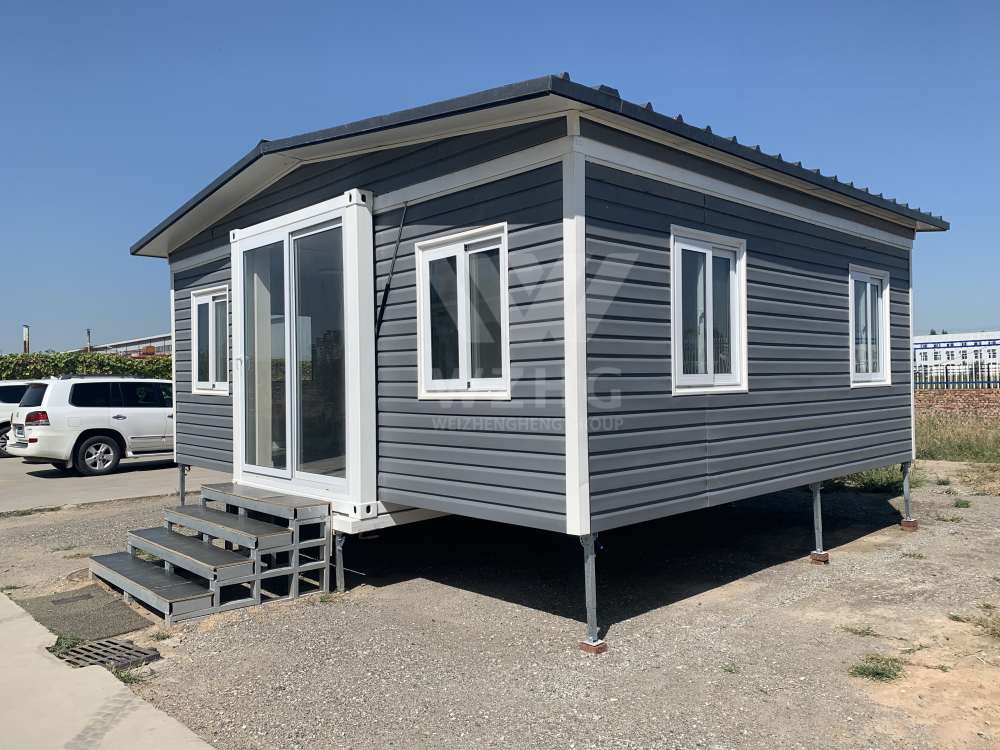
The durability of expandable container houses mainly depends on the quality of the steel structure,the level of anti-corrosion treatment,the design of the expansion mechanism,the strength of connection points,and the overall waterproofing and insulation system—rather than simply whether it is“converted from a container.”
In many people’s imagination,container houses seem to be nothing more than cutting and assembling a metal box.In reality,the essence of an expandable structure is closer to an industrialized prefabricated steel building system.
Industry experience shows that the key factors affecting durability usually include:
High-quality products commonly use high-strength structural steel rather than ordinary thin sheet metal.In typical designs,the thickness of the main structural steel usually ranges between 2.5mm and 4mm.
For comparison:
Ordinary lightweight prefab housing steel thickness:approximately 1.2mm–1.8mm
Industrial-grade modular building steel thickness:2.5mm and above
Greater steel thickness and a well-designed load-bearing structure directly determine whether the building remains stable after expansion.
Many people instinctively believe that the durability of steel-structure buildings mainly depends on whether the steel is thick and strong enough.In real-world use,however,the true“enemy”of steel is often not load-bearing capacity,but corrosion.
Steel is a very stable and high-strength material,but it has one natural weakness—when exposed to moisture for long periods,especially in high-humidity or salt-laden environments,oxidation(rusting)can gradually occur.This process does not cause immediate structural collapse,but it quietly weakens material performance over time.
Steel structures without effective anti-corrosion treatment may show obvious rust within 3–5 years in humid or salt-spray environments.
With a mature anti-corrosion system,such as galvanization or multi-layer industrial coatings,structural lifespan can extend to 15–25 years or even longer.
For this reason,modern expandable container houses usually undergo dedicated surface treatments before leaving the factory,such as:
Hot-dip galvanizing—forming a protective layer on the steel surface to delay oxidation
Epoxy zinc-rich primer+polyurethane topcoat—providing multi-layer protection
Industrial-grade multi-layer anti-corrosion systems—for more demanding environments
These treatments are not decorative processes;they directly relate to the condition and safety of the building after many years of use.
Unlike traditional buildings,expandable container houses are not entirely static structures.Their design relies on mechanical components such as hinges,sliding rails,and support systems to complete the expansion process,adding a unique dimension to durability—the reliability of moving structures.
In practical use cases,an interesting phenomenon often appears:
Many functional issues do not originate from walls or the main structure,but from the wear of moving mechanisms after repeated use.
For example:
Hinge metal fatigue
Sliding rail precision decline
Loosening of connection components
Deformation of load-bearing panels
These issues do not appear immediately but accumulate gradually with frequency of use.Therefore,high-quality products typically invest more engineering effort into these details,including:
Industrial-grade hinge systems designed for long-term opening and closing
Thickened load-bearing connection plates for improved structural stability
Anti-fatigue metal structural designs to reduce wear risks
Simply put,the quality of the expansion mechanism often directly determines whether the house can remain stable over the long term.
Any expandable structure undergoes changes in load transfer during expansion.When the house shifts from folded to expanded state,force paths change,meaning certain areas may bear higher stress.
These stress concentration areas usually include:
Folding edge positions
Expansion seam areas
Load-transfer nodes
If these areas lack sufficient reinforcement or design optimization,they may become potential weak points over time,leading to minor deformation,seam loosening,or even localized fatigue damage.
Excellent structural design reduces these risks by adding reinforcements and optimizing load paths,allowing the expanded structure to approach the stability of a fixed building.
In real-world use,“durability”does not only refer to structural strength but also to a commonly overlooked issue—long-term waterproof performance.
Compared to many structural problems,continuous water leakage can be more destructive.When moisture enters the structure,it may cause:
Hidden corrosion
Insulation damage
Interior material aging
Local structural degradation
Therefore,high-quality expandable container houses typically emphasize waterproofing details in their design,such as:
Multi-layer sealing strips to prevent rainwater intrusion
Roof drainage design to prevent water accumulation
Seam drainage logic to reduce leakage risks
These systems may not enhance visual appeal,but they are among the most critical guarantees for long-term use.
Under reasonable design and normal maintenance conditions,the service life of expandable container houses typically reaches 15–25 years or more,with high-specification products lasting even longer.
There is no unified durability standard,as product grades vary greatly.
Based on industry experience:
Product Grade | Typical Lifespan |
Basic Economic Type | 10–15 years |
Standard Engineering Type | 15–25 years |
High-Specification Building Grade | 25+ years |
It must be emphasized that lifespan is not determined solely by materials,but also closely related to maintenance and usage methods.
The sealing system is a key factor affecting durability.In normal climates,inspection is recommended every 6–12 months;in high-humidity,coastal,or cold regions,every 3–6 months is advised.Focus on checking whether door and window rubber strips are aging or cracked,whether folding connection points show leakage,and whether roof joints are loose.
Seal aging is a primary cause of leakage.Once water enters the wall or steel structure,it accelerates corrosion and affects insulation performance.A reasonable replacement cycle is typically 3–5 years.Well-maintained sealing systems can extend overall lifespan by approximately 3–5 years.
While steel structures have high inherent strength,the anti-corrosion system largely determines service life.Annual visual inspections are recommended to check for peeling paint,blistering,or rust spots.Depending on environmental conditions,partial repainting or full refurbishment should be carried out every 5–8 years.In high salt-spray coastal areas,this cycle should be shortened to 3–5 years.
Timely repair of scratches or coating damage prevents corrosion from spreading.Proper anti-corrosion maintenance can extend structural durability from around 15 years to 20 years or more.
The core of expandable container houses lies in their moving structure,including hinge systems,locking mechanisms,connection bolts,and load-bearing support points.It is recommended to check fastening conditions every 6 months and conduct annual lubrication.For high-frequency expansion scenarios(such as commercial rental or temporary office use),inspections every 3 months are advised.
Loose or worn connection components may lead to uneven stress distribution and increased structural fatigue,shortening service life.Standard maintenance can reduce failure rates and extend safe service life by approximately 5 years.
No.As long as the structural design meets engineering standards,the expansion mechanism itself does not reduce stability.The key lies in load path design and rigid locking systems after expansion.
Modern expandable houses are not merely“folding boxes,”but structural systems with clear mechanical logic.After expansion,they typically rely on:
Hinge fatigue:Frequent opening and folding subjects hinges to cyclic stress;insufficient material strength may lead to loosening,deformation,or fracture.
Poor welding:Substandard weld quality or inadequate process control may cause stress concentration,leading to cracking or structural hazards over time.
Deformation of connection components:Bolts,locks,or support elements may deform under uneven or excessive load,affecting stability.
Seal aging:Rubber or sealing materials degrade under UV exposure,temperature fluctuations,and humidity,leading to leakage and accelerated corrosion.
High-quality expandable container houses can adapt to most common climate conditions,but their risk resistance depends on structural grade,anchoring methods,and engineering standards.
In real life,extreme weather threats mainly include strong winds,heavy rain,and temperature fluctuations.If reinforcement is insufficient or foundation systems are unstable,deformation,seal failure,or localized damage may occur over time.
Quality products typically consider these factors during design:reinforced roof and wall beams,rigid locking systems after expansion,foundation designs capable of resisting wind and water erosion,and roof and seam drainage systems guiding rainwater safely away.
Through these comprehensive measures,high-quality expandable houses can resist common weather variations and even adapt to temporary extreme conditions,ensuring safer and more reliable use.
Lifespan issues usually stem from low manufacturing quality or simplified design,not from the expandable concept itself.
Low-cost products often compromise on steel thickness,anti-corrosion treatment,and expansion mechanism design.Thin steel may deform under long-term stress;inadequate anti-corrosion treatment leads to rust;poorly designed hinges and rails may jam or wear within one or two years;simplified sealing systems may allow rainwater intrusion,accelerating corrosion and material aging.
These issues lead some users to perceive expandable houses as“not durable,”when in fact the problem lies in low engineering-grade products.Price and engineering quality are generally positively correlated:higher engineering grade means thicker steel,better anti-corrosion treatment,more reliable mechanical components,and longer service life.
Durability should be evaluated based on structural engineering parameters,anti-corrosion systems,manufacturing details,and certification documents—not just appearance or price.
Key considerations include:
Steel thickness and grade
Anti-corrosion treatment methods
Expansion structure design
Environmental adaptability
Comprehensive evaluation of these details significantly reduces long-term risks.
Are Expandable Container Houses Suitable for Long-Term Use?
Provided engineering standards are met,expandable container houses are fully suitable for long-term use.
Modern expandable houses are no longer merely temporary buildings.Their design and materials can support long-term residential and commercial applications.With proper reinforcement and anti-corrosion treatment,they can serve as family homes,offices,or even tourism accommodations.
Many real-world cases demonstrate their reliability for long-term office use,remote living,and hospitality projects.
When choosing expandable container houses,the manufacturer’s engineering experience and production system often matter more than single product parameters.WZHhouse is a professional container house manufacturer from China,specializing in modular and expandable building systems.
Unlike many export-only suppliers,WZHhouse has established a closer-to-user service system in overseas markets and maintains an office in Australia to provide convenient communication and support.
Through standardized production processes,strict material control,and mature structural design experience,WZHhouse products are widely used in residential,commercial,and temporary facility applications.
For users who value durability and structural reliability,choosing a manufacturer with engineering capability and long-term service support often brings greater long-term value than simply pursuing low prices.
Expandable container houses can be highly durable—provided that structural engineering,anti-corrosion systems,and manufacturing quality meet appropriate standards.
What truly determines durability is not the“expandable”form itself,but the engineering logic and manufacturing level behind it.High-quality products can approach or even rival many traditional building systems in lifespan and reliability,while low-quality products may reveal issues within a few years.
Therefore,instead of simply asking“Are they durable?”,the more accurate question is:What type of product and manufacturer are you choosing?



Copyright © Hebei Weizhengheng Modular House Technology Co., Ltd. All Rights Reserved
Sitemap

 +8615081877521
 +8615081877521